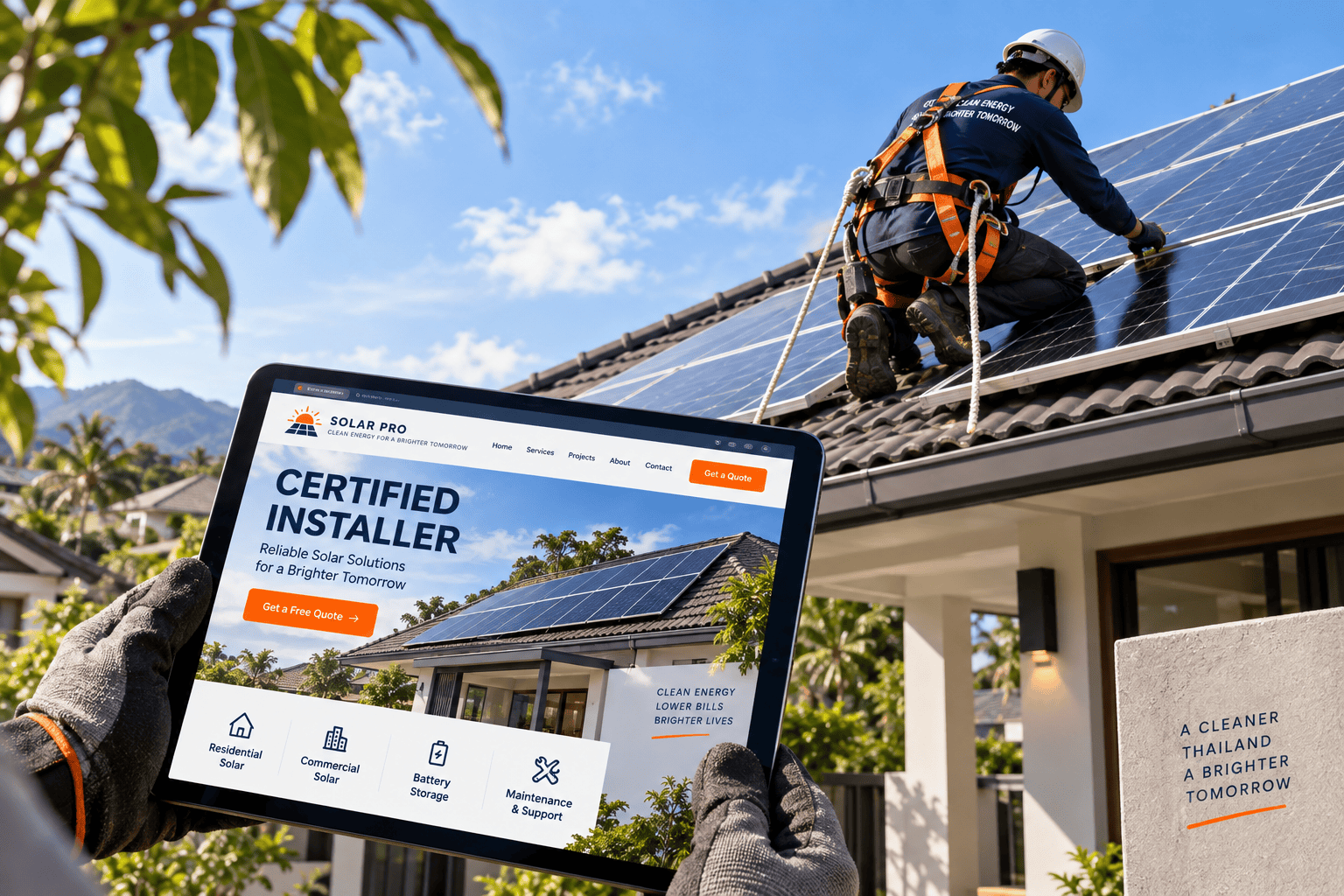
If you run a solar installer website in Thailand — or you’re about to need one — this is the month it starts to matter. The government is about to subsidise rooftop solar at ฿50,000 per household, targeting numbers in the hundreds of thousands to over a million, with public registration opening mid-October 2026. If you’ve just filed your vendor registration with the utility, the next question isn’t whether you’ll be approved. It’s whether those households will find you — or your competitor down the road.
📅 Policy details as of 15 September 2026. The programme is still being finalised and specifics may change. Confirm current details with MEA Call Center 1130 or PEA Contact Center 1129.
What the ฿50,000 solar rooftop subsidy actually is
What households get
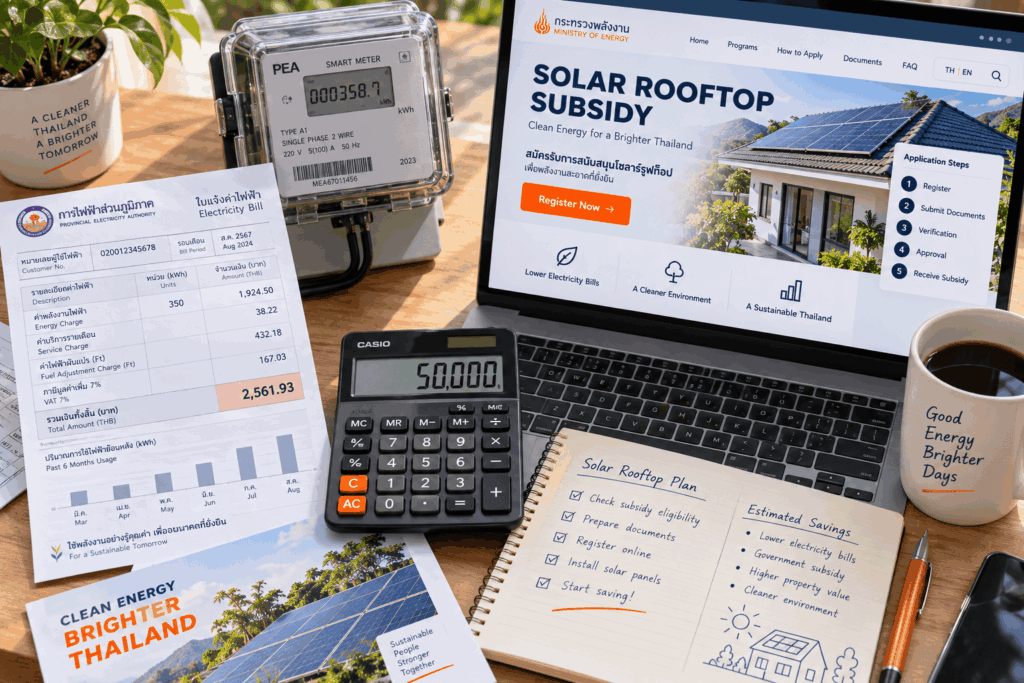
The government has earmarked roughly ฿50 billion (from the 2026 energy emergency borrowing decree) to subsidise rooftop solar installation at ฿50,000 per household. The announced first phase targets 500,000 households, with reported plans to expand toward 1–1.5 million. What makes this different from earlier schemes:
- No money up front — delivered with the state banks (GSB, GHB, BAAC)
- Electricity meters as the eligibility basis, with the utility installing smart meters to support selling power back
- Income from exported power automatically offsets the loan instalments — a 5 kW system is estimated at around ฿1,000/month, depending on household consumption
- Public registration from mid-October 2026, running through the end of the following year
In business terms: the price barrier that has made Thai homeowners hesitate for a decade is about to disappear nationwide, in a single month.
What installers must do, and by when
The Metropolitan Electricity Authority (MEA) and Provincial Electricity Authority (PEA) opened vendor and equipment registration from 3 August to 30 September 2026:
- Installers must meet the qualifications and standards set by the utilities
- Equipment must carry international certification such as IEC plus Thailand’s TIS (มอก.) standards — covering panels, inverters, breakers, fuses, cabling and lithium batteries
- Engineers and installation technicians must meet the required standards, with government-run skills training supporting the rollout
- MEA and PEA will jointly supervise installation standards and after-sales service
And here’s the sentence that matters most to you: households will choose from the list of certified vendors. If you haven’t filed yet, contact any MEA or PEA branch, or call 1130 (MEA) or 1129 (PEA). There’s less than two weeks left.
Why being certified isn't enough
Picture the moment the certified vendor list goes public. A homeowner sees your company name — alongside dozens of others in the same province. The first thing they do is search your name on Google.
Find a website that states clearly what you do, how many systems you’ve installed, which brands you fit, what the warranty covers, with real photos from real rooftops? You get the call.
Find only a Facebook page last updated four months ago — or nothing at all? They click the next name on the list. Certification gets you into the race. It doesn’t win it.
This matters more in solar than in most trades, because the customer is spending six figures, bolting it to their own roof, and living with it for twenty years. Their number one worry is “who fixes it when it breaks?” — a question a Facebook page cannot answer, and a well-built website answers before they ever message you.
How homeowners will actually pick an installer
Channel 1: Google search
The searches about to spike are “solar installation + province name”, “rooftop solar [province]”, and “certified solar vendor [province]”. Whoever ranks on page one in their own province takes this wave of customers — and right now almost nobody is competing seriously. That window is open for a few months, not forever.
Channel 2: asking AI
More people every month ask ChatGPT, Gemini or Google AI directly: “who’s a good solar installer in Phuket?” AI answers from websites it can read and understand. It cannot read your Facebook page. Only a site with correct, structured content stands a chance of being cited.
Channel 3: a referral, then an online check
Even when your name comes from a neighbour, the customer still searches you before calling. That’s the step where deals quietly disappear — and you never know it happened, because they never contacted you at all
Eight things a solar installer website needs to win the job
- Your utility registration status, visible on the homepage — this is your single biggest differentiator this year. Don’t bury it on the About page
- The equipment standards you use — panel and inverter brands with IEC/TIS certification. Customers are comparing anyway; make it easy to compare on your site
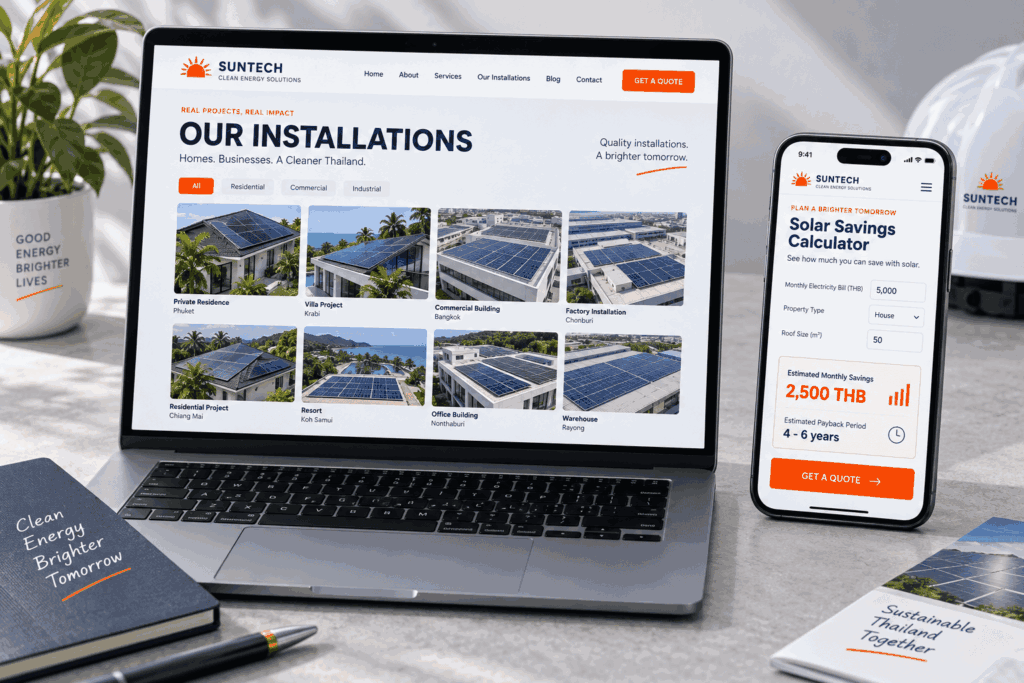
- Real installations with real photos — system size, location, and before/after electricity bills. Your own site photos beat stock imagery every time
- The subsidy and financing explained on one page — most customers still don’t understand who pays first or how repayment works. Whoever explains it most clearly gets the conversation
- A basic sizing tool — enter a monthly bill, see a suggested system size and rough payback. This is the single best lead magnet in this industry
- A clear service area — name the districts and provinces you actually reach. It helps customers and it helps Google
- Fast on mobile — people open your site on a phone while staring at their electricity bill. A slow site ends there
- Contact that reaches a human — LINE and call buttons on every page, not a form nobody answers
For what this level of website costs, see our 2026 website price guide for Thailand
The timeline left — when you need to be live
A standard website takes 4-6 weeks to build, and Google needs another 4-8 weeks before rankings settle. Counting back from mid-October, right now is the last comfortable moment to start.
If you’re on the Andaman coast, our team is actually based here — see our web design services for Krabi, Khao Lak & Phang Nga and Phuket.
FAQ
Yes — run them in parallel. The material a website needs (equipment specs, standards, team credentials, past projects) is the same material the registration requires. Do it once, use it twice, then add the certification badge to your homepage when approval comes through.
Because of three things a page can’t do: rank on Google when someone searches with a province name, be readable by AI when someone asks for an installer recommendation, and present the technical specs, project history and warranty terms a six-figure customer needs. A page still builds awareness; the website closes the sale.
A standard 5-page website takes 4-6 weeks. Start in September and you’re live in early-to-mid October, right as public registration opens. Later is still possible — you’ll just be competing after everyone else is already online.
A standard 5-page WordPress site starts at ฿25,000. Adding a savings/payback calculator and a structured project gallery is quoted by scope. Compare that against the margin on a single installation and work out how many extra jobs it takes to pay for itself.