The honest playbook for SME owners in Bangkok, Krabi, and across Thailand who want to win in the AI era.
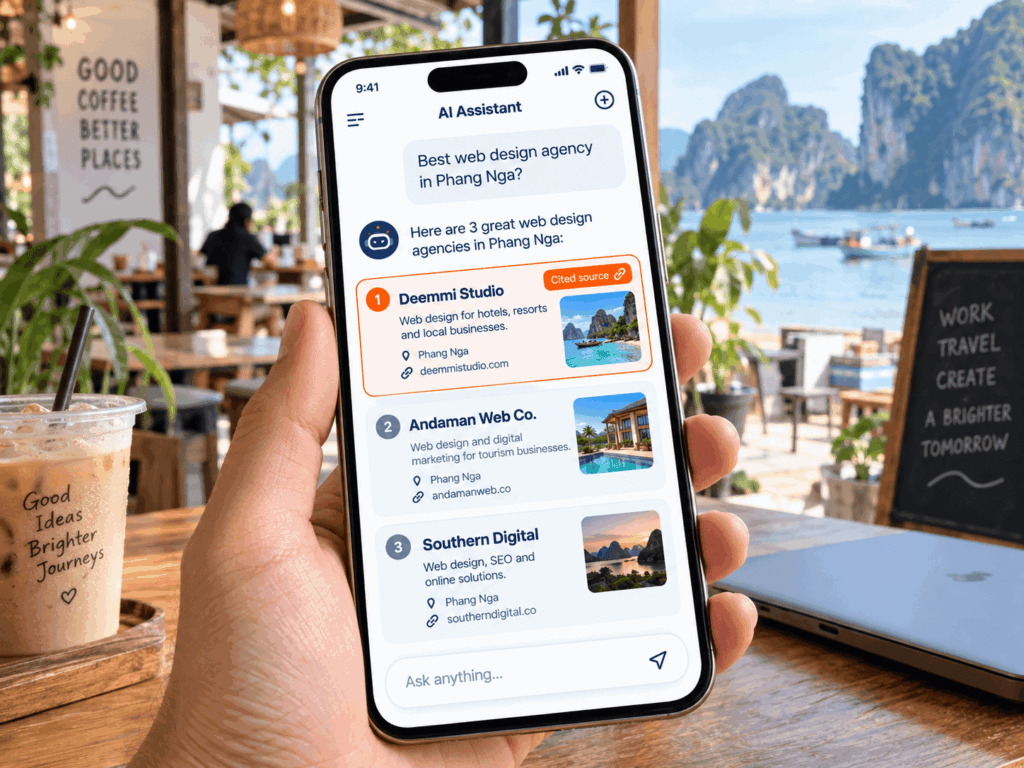
A year ago, most Thai business owners obsessed over one question: “Are we ranking on Google?” Today, the question has changed. When a customer wants a recommendation, they often skip Google entirely and ask ChatGPT, Gemini, or Perplexity directly: “What’s the best digital marketing agency in Bangkok?” — and the AI gives them a single confident answer.
If your business isn’t in that answer, you don’t exist for that customer.
This is why AEO (Answer Engine Optimization) is no longer a buzzword — it’s the new front door. In this guide, we’ll show you the five techniques our team uses to make Thai SME websites trustworthy enough that AI engines actually recommend them. No theory. No fluff. Just the playbook we apply to every WordPress site we build for businesses in Thailand.
Why Being "Recommended by AI" Matters More Than Ranking on Google
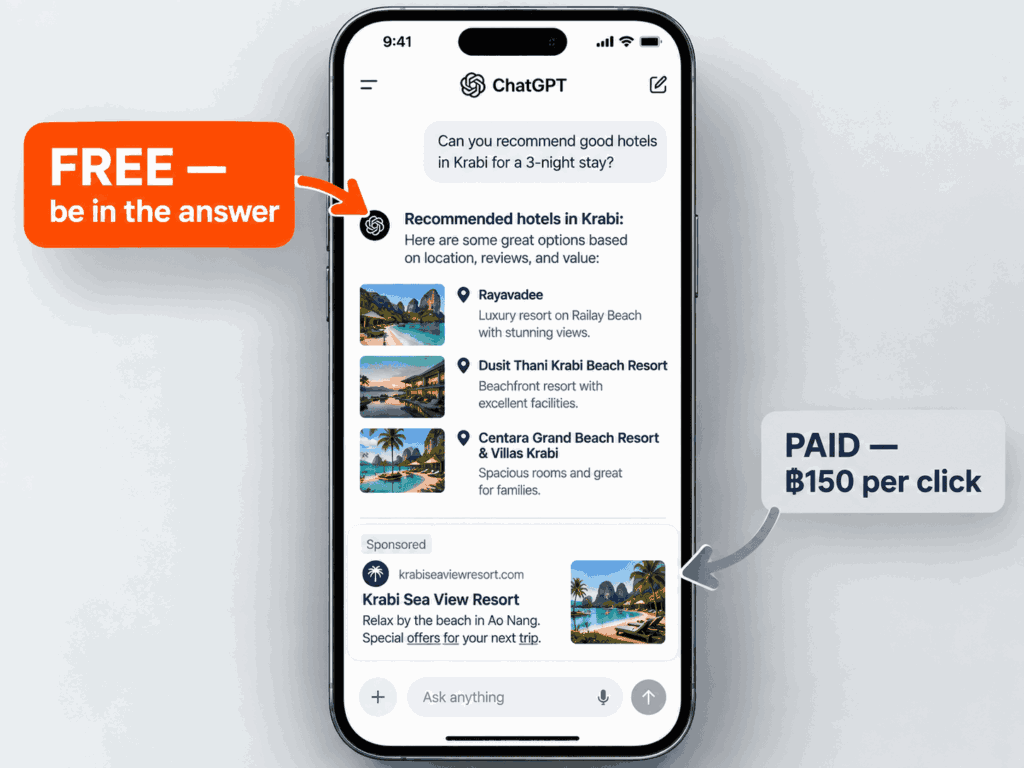
Google’s first page used to be the prize. You’d compete for ten spots, and traffic would flow. That model is breaking down — and fast.
In 2026, more than 60% of customer searches end before the user clicks a single link. They ask the AI, get an answer, and act on it. ChatGPT’s Search feature, Google’s AI Overviews, Perplexity’s citations — all of them now answer questions directly, often without ever sending the user to a website.
That changes the game completely. You’re no longer competing for clicks. You’re competing to be the source the AI references. And that requires a different strategy.
AI Is Your Customer's First Filter
Think of how customers research today:
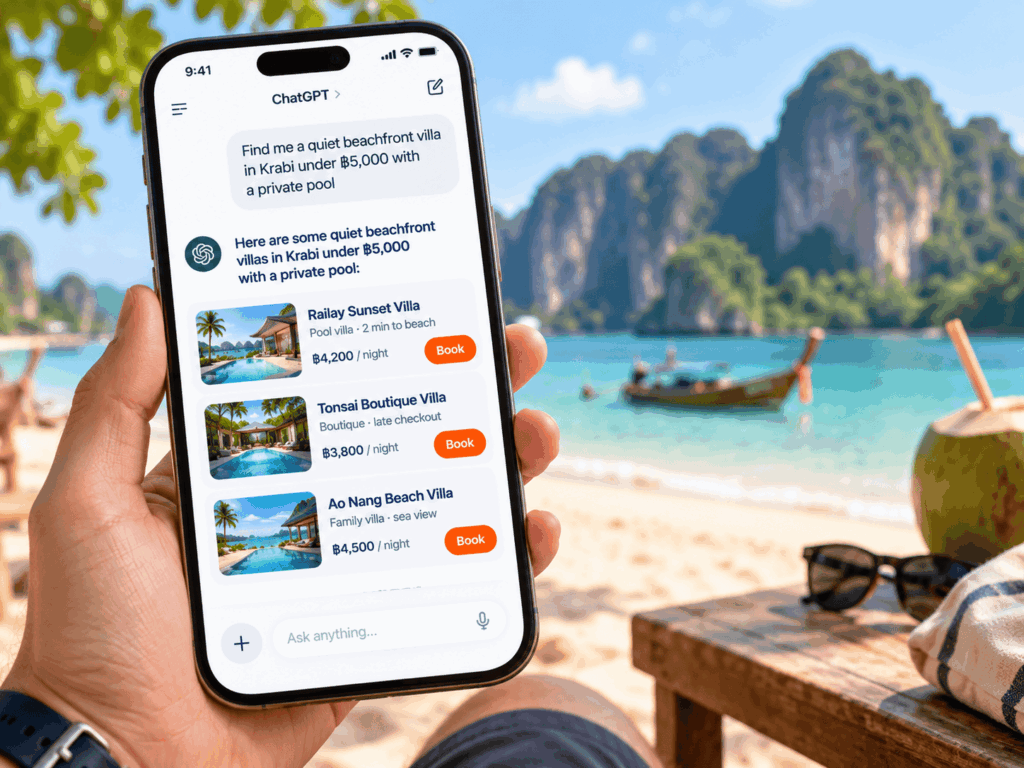
- They ask ChatGPT: “Which web design agency in Krabi works with hotels?”
- ChatGPT names two or three brands, with reasons.
- The customer then Googles those names — already pre-qualified.
- They contact only the businesses the AI vouched for.
If your business isn’t in step 2, you never get to step 4. The AI isn’t just a search engine anymore. It’s a recommendation engine. And businesses that don’t optimize for it will quietly disappear from consideration.
Trust Transfers — When AI Recommends You, Customers Believe
Here’s the under-appreciated part: when an AI recommends your business, the customer treats it like an unbiased third-party endorsement. AI doesn’t have a sales agenda (in the customer’s mind), so the trust signal is stronger than any ad you could run.
We’ve watched Thai brands that invested in AEO over the last 18 months land 3-5x more high-intent leads — not from more traffic, but from better traffic. The leads come pre-convinced. They already trust you because the AI did. Closing rates double. Sales cycles shrink. CPA drops.
This is the actual prize of the AI era — and it’s available right now to any business willing to play the new game.
5 Techniques to Build a Website AI Engines Trust
Five techniques. Each one moves the needle. Combined, they make your business the obvious recommendation for AI engines covering your industry in Thailand.
1. Be a Real Expert — Build Deep Content, Not Sales Pages
AI engines reward depth. They penalize sales fluff. The single biggest mistake we see Thai businesses make is publishing 500-word “blog posts” that say nothing new and end with a CTA. AI ignores that content. It cites the 2,000-word piece that explains how something actually works.
What this looks like in practice:
- A hotel in Krabi writing a 2,500-word guide to “best Krabi beaches for families with toddlers” — with specific names, costs, and seasonal notes. AI cites it when parents ask the question.
- A Bangkok WordPress agency publishing a real comparison of WooCommerce vs Shopify for Thai e-commerce — with actual transaction fees, payment gateway details, and screenshots. AI cites that, not the surface-level article.
- A clinic writing detailed answers to specific medical questions, with proper E-E-A-T signals (author, credentials, sources). AI cites that over the marketing-heavy competitor.
The lesson: content depth signals expertise. Thin content signals nothing. If you publish, publish deeply — or don’t publish at all. (See our SEO and content services for Thai businesses for the framework we use with clients.)
2. Structure Your Site So AI Can Read It (Schema Markup)
This is the most under-used technique in Thailand right now — and the highest-leverage one.
AI engines don’t read your website the way humans do. They parse structured data — invisible code that tells the AI exactly what each page is, who wrote it, when it was updated, what questions it answers, and how it connects to the rest of your business.
The five must-have schemas for any Thai SME website:
- Organization — your business name, address, contact, social profiles. (Lives on your homepage.)
- LocalBusiness — same as Organization but with local-search signals (geo coordinates, hours, price range).
- Article / BlogPosting — every blog post needs this with author + publish date + topic.
- FAQPage — for any post or page with a Q&A section. This is what ChatGPT cites.
- Person — for the author behind each piece of content. AI uses this for E-E-A-T trust signals.
Without these, your site is invisible to AI in a structural sense — even if your content is great. Plugins like Rank Math do most of the heavy lifting on WordPress, but you need to actually configure them. (We cover this in our WordPress design service for Bangkok and Krabi businesses).

3. Build a Network of Trust Signals (Backlinks + GBP + Citations)
AI engines don’t trust you because you say you’re an expert. They trust you because other authoritative sources point to you. This is the timeless principle behind Google’s PageRank, and it’s even more important for AI engines that need to verify their answers.
Three trust networks that matter most for Thai businesses:
- Google Business Profile (GBP) — fully verified, with consistent NAP (name, address, phone), photos, posts, and customer reviews. AI cross-references GBP data heavily.
- Industry citations — directories specific to your niche (TripAdvisor for hospitality, Yelp for services, BNI Thailand for B2B). Consistent brand info across all of them.
- Quality backlinks — links from authoritative Thai sources (Bangkok Post, Thai Industry Network, university sites, local government partnerships). Quality matters far more than quantity.
You don’t need 1,000 backlinks. You need 30 of the right ones. We’ve worked with clients in Krabi who jumped from “invisible to AI” to “always cited” in eight months by focusing on trust networks over raw link volume.
4. Answer Questions Customers Are Already Asking (Powerful FAQ Sections)
ChatGPT and Perplexity especially love FAQ sections — because that’s exactly the format they need to surface in their answers.
But there’s a right way and a wrong way to do FAQ.
Wrong way: generic questions like “What is digital marketing?” with copy-paste answers.
Right way: the specific questions your real customers actually ask, answered with concrete numbers, examples, and context. We typically aim for 5-8 FAQ items per important page, each answer 50-80 words, all wrapped in proper FAQPage schema.
For a Krabi hotel, that might mean: “Is Ao Nang or Railay Beach better for families with kids?” — answered honestly, with specifics. For a Bangkok WordPress agency, it might be: “How much does a WooCommerce site with Thai payment gateways actually cost?” — answered with real price ranges.
When ChatGPT looks for an answer to that specific question, your page becomes the source. (For more practical AEO insights, browse our latest articles for Thai SMEs).
5. Make Your Data the Reference (Original Research + Unique Content)
The final and most powerful technique: become the source.
AI engines synthesize information across thousands of sources, but they always trace back to original data and primary sources when given a choice. If you publish original research, original frameworks, or original case studies — AI will cite you over the dozens of generic articles that copy each other.
What “original” looks like for a Thai SME:
- A hotel sharing their own analysis of “average occupancy rates by month in Krabi 2026” with their own data.
- A WordPress agency publishing “actual page speed scores from 50 Thai e-commerce sites” with screenshots.
- A clinic publishing “patient outcomes from 100 procedures” with anonymized data and methodology.
This isn’t easy. It takes effort. That’s exactly why it works — most competitors won’t do it. The ones that do become the reference, and AI references the reference.
Deemmi Doesn't Just Build Websites — We Build AI Authority
Most agencies in Thailand still pitch you “SEO” as if it’s 2018. We’ve spent the last three years rebuilding our entire methodology around AEO + GEO (Generative Engine Optimization), because we’ve watched the rules change in real time.
When we build a WordPress site for a Thai SME, every one of these five techniques is baked in from day one:
- Content frameworks designed for depth, not word-count theater
- Full schema implementation across every page type
- Trust network strategy (GBP optimization, citation building, ethical link development)
- FAQ schemas on every page that needs one
- Original-content roadmaps so you become the reference, not the echo
This is the foundation we built for clients ranging from Krabi resorts to Bangkok B2B services. The pattern is consistent: clients implementing this playbook see AI-citation traffic begin within 60-90 days, and pre-qualified leads grow steadily from month four onwards.

👉 Curious whether AI is already mentioning your business — or your competitors? Book a free 30-minute AEO consultation with our team and we’ll run a live check during the call. We’ll show you exactly what ChatGPT and Perplexity say about your industry, where you stand today, and the three highest-leverage moves you can make this quarter.
Frequently Asked Questions
Traditional SEO targets Google’s blue-link results — you optimize to rank in the top 10. AEO (Answer Engine Optimization) targets AI engines like ChatGPT, Gemini, Perplexity, and Google AI Overviews — you optimize to be cited in their answers. The principles overlap (content quality, structured data, trust signals), but the goals are different. AEO is about being the source AI references, not just appearing in a list.
How long until AI starts recommending my business?
ChatGPT (largest user base globally), Google AI Overviews (already integrated with Google Search in Thailand), and Perplexity (growing fast among professional users). Gemini is rising. The good news: optimizing for one tends to help all of them, because the underlying signals (content depth, schema, authority) are similar.
Deemmi’s AEO consulting starts at 15,000 THB/month for ongoing optimization (audit, schema implementation, content strategy, monitoring across AI engines). One-time AEO audits start at 25,000 THB for a comprehensive baseline plus a 90-day action plan. Free initial consultation is always available.
AEO actually favors small, niche businesses more than large brands. AI engines reward specific expertise over broad authority — meaning a Krabi-only dive shop with deep specific content can outrank a national chain in AI recommendations for “best dive shop in Krabi.” For SMEs, AEO is the most level playing field marketing has had in years.
Yes — if you have technical SEO knowledge, time to implement schema correctly, content writing skills, and tools to monitor AI mentions. The challenge isn’t any single piece — it’s executing all five techniques consistently for 6+ months. Most Thai SMEs hire an agency for the systematic implementation and reserve their own time for high-quality original content.
The fastest free check: open ChatGPT, Gemini, or Perplexity in incognito mode and ask each one “Best [your category] in [your city]” — see if your brand appears in the answer. Repeat with 5-10 variations of the query your customers actually use. If you appear consistently — you’re winning. If never — you have work to do. We run this exact diagnostic in our free 30-minute consultation.
Publishing thin content. We see it constantly: a 400-word “blog post” with a sales CTA, no schema, no specifics, no original perspective. AI engines ignore that content completely. The fix is hard but simple — write fewer pieces, but make each one deeply useful. One genuine 2,500-word guide outperforms twenty 400-word posts every time.
Ready to bring your business online with a strategy that actually works? Let’s talk — reach us at info@deemmi.com or chat with our team on LINE @deemmi.