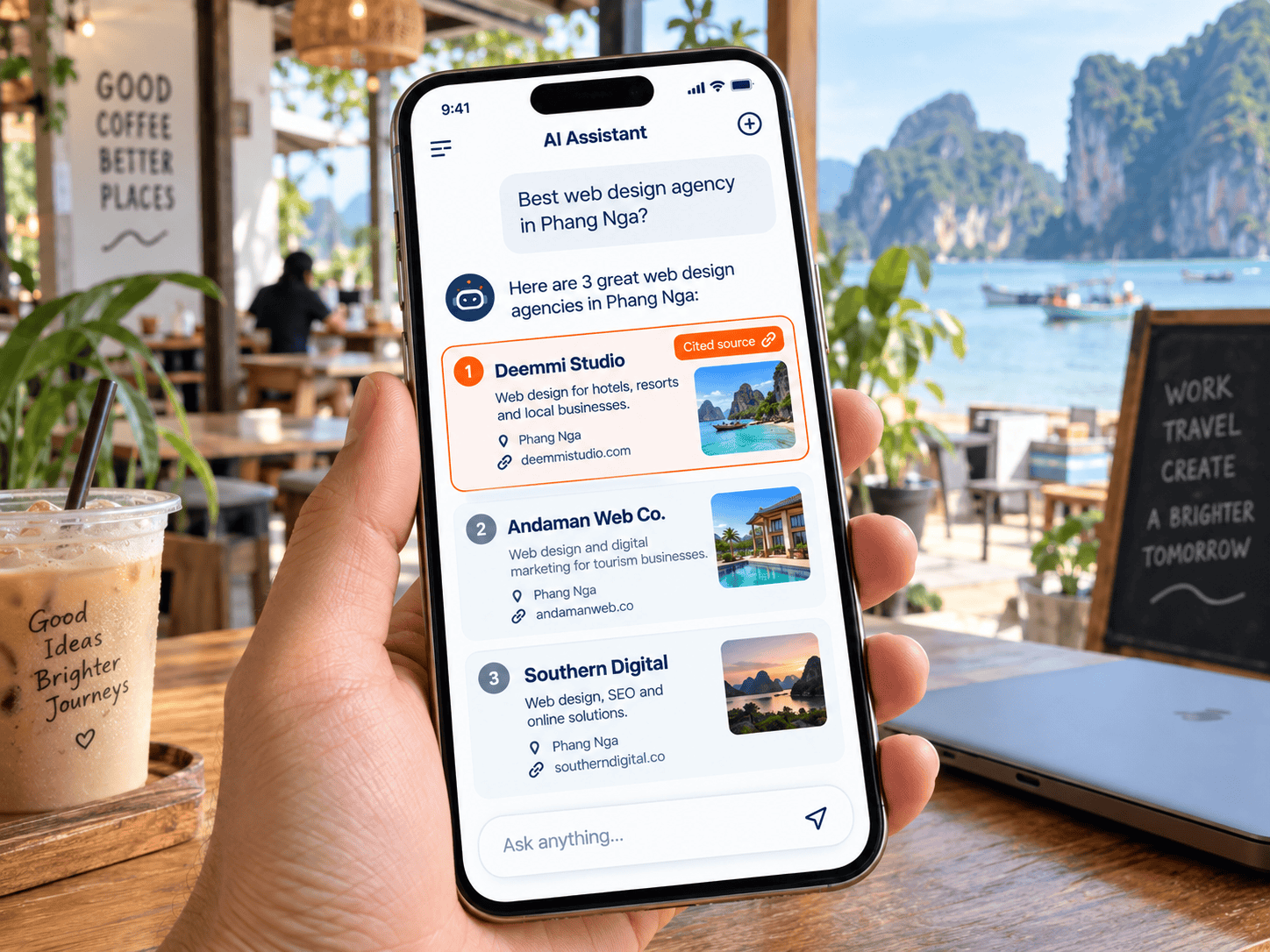
Ask Google “best web design agency in Phang Nga” today and an AI answer appears above every link, naming only a handful of businesses. Getting your name into that answer is called GEO.
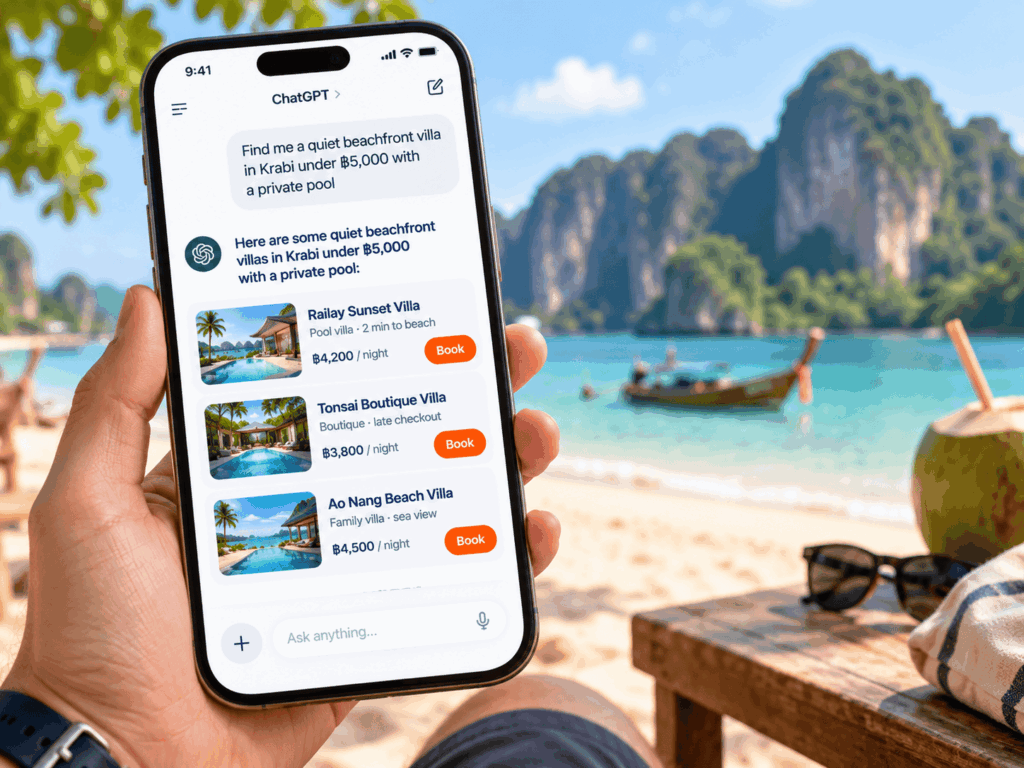
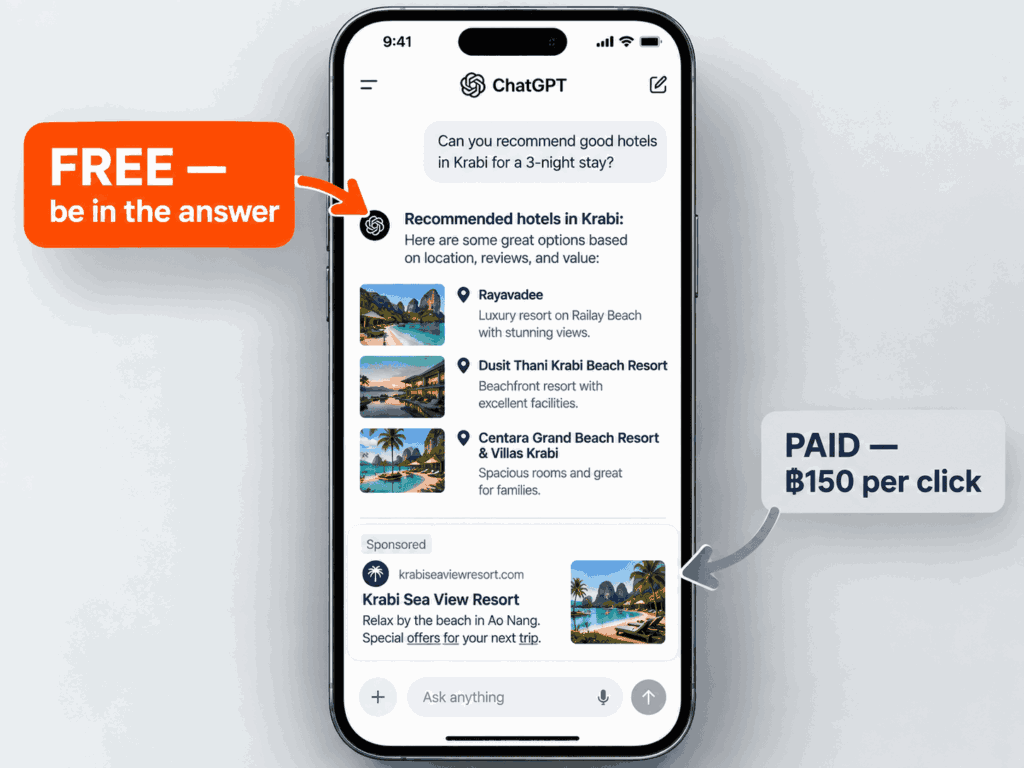
People no longer ask AI only on Google. ChatGPT just opened ads in Thailand at the end of September, and AI is starting to book hotels for travellers in some markets. If a customer asks AI and the AI doesn’t know you, you’re not in that market.
📅 Information as of 10 October 2026
What is GEO?
GEO (Generative Engine Optimization) is the work of making your website and business information easy for answer engines such as Google AI Overviews, Google AI Mode, ChatGPT, Gemini and Perplexity to understand, trust, and cite or recommend in their answers. The goal isn’t just a ranking — it’s being named in the answer the customer actually reads.
The term comes from a Princeton and IIT Delhi paper published at KDD 2024. Testing 10,000 queries, the researchers found that optimising content for generative engines lifted its visibility in AI answers by up to about 40%, with lower-ranked pages gaining the most.
How GEO differs from SEO
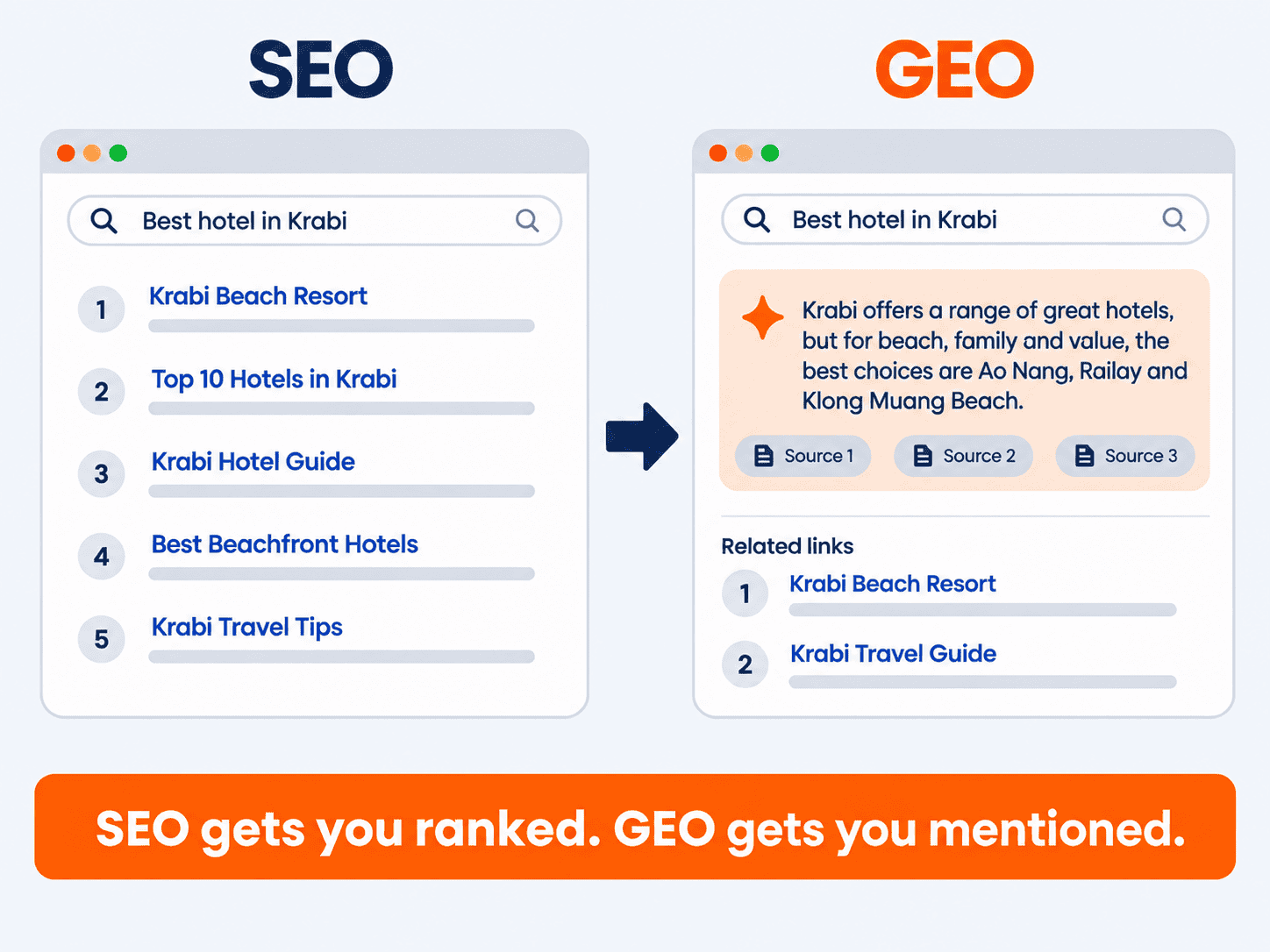
SEO gets your page ranked in the list of links. GEO gets AI to use your information when it writes the answer. One doesn’t replace the other — GEO is built on SEO. If Google can’t crawl your site, AI can’t use it either.
| Aspect | SEO | AEO | GEO |
|---|---|---|---|
| Goal | Rank in the list of links | Be pulled as a short answer (featured snippet, voice assistant) | Be named and cited inside AI answers |
| Where customers see you | Blue links on Google | Answer box at the top | AI Overviews, AI Mode, ChatGPT, Gemini, Perplexity |
| Measured by | Rankings, clicks | Winning the answer box | Mentions, citations, clicks from AI |
| Foundation needed | Fast, crawlable site | Short, direct answers | Both, plus numbers, proof, schema and consistent facts everywhere |
GEO doesn't replace SEO; it builds on it
Why GEO matters in 2027
- Google AI Mode now speaks Thai. In October 2025 Google expanded AI Mode to 35 more languages, Thai included, so Thai users can search conversationally inside Google.
- People click fewer links when an AI answer appears. Ahrefs found AI Overviews cut clicks to the #1 result by 34.5% (March 2025), rising to about 58% in its late-2025 re-run. Pew Research found users clicked a result 8% of the time with an AI summary, versus 15% without.
- Ranking well doesn’t guarantee a citation. Ahrefs data suggests only about 38% of URLs cited in AI Overviews also rank in the top 10 — so mid-ranking pages can win if they answer the question precisely.
Put simply, the way customers find businesses is moving from a list of links to a ready-made answer. Businesses missing from that answer fade from view even while their SEO rankings hold.
What happened to SGE?
If you’ve read about SGE (Search Generative Experience), that was the name of Google’s 2023 experiment. It’s gone. SGE became AI Overviews (the AI answer box above results) from mid-2024, followed by AI Mode (a full-page conversational search). The principles of getting cited haven’t changed, which is why the industry now calls the discipline GEO.
How AI decides which websites to cite
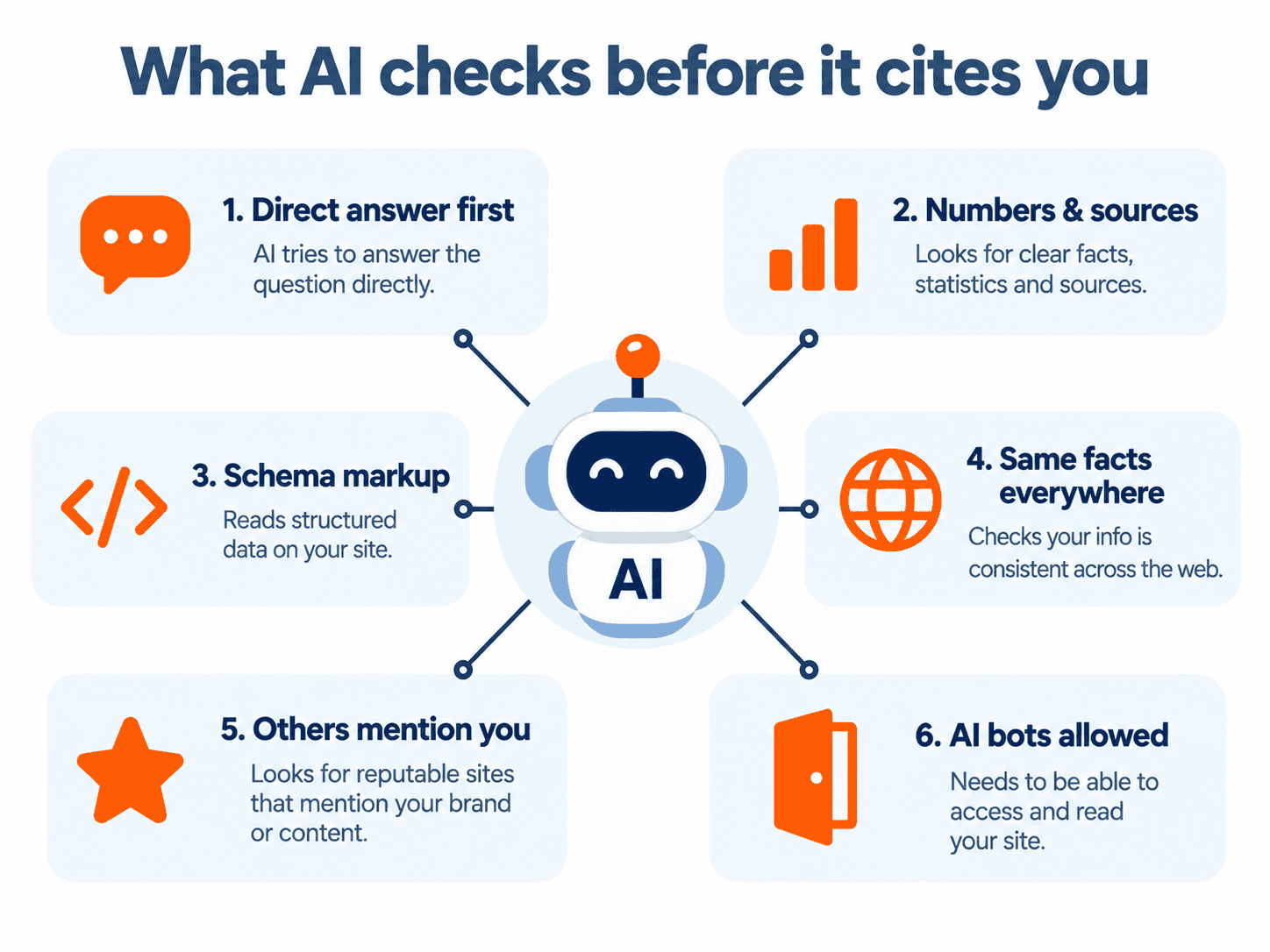
Nobody outside Google or OpenAI knows the full formula, but research and our own testing point to six signals.
1. A direct answer first
AI favours content it can lift straight into an answer. Open with a clear two-to-three-sentence answer, then explain. Headings should be the questions customers really ask, such as “How much does a hotel website cost?”, not abstract concepts.
2. Numbers and sources
The GEO research found that adding statistics, expert quotes and cited sources worked best, while keyword stuffing did little or made things worse. “From ฿15,000, ready in three weeks” beats “affordable pricing” every time.
3. Schema that says who you are
Schema is code visitors never see but which tells AI exactly what your business is, where it is, what you offer, what it costs and which questions you answer (Organization, LocalBusiness, Service, FAQ). Less guessing for the AI.
4. The same facts everywhere
Your name, address, phone, services and prices should match on your website, Facebook and directories. AI cross-checks sources; if yours conflict, it trusts a competitor with steadier data.
5. Others talking about you
AI weighs what others say about you — reviews, press, partner sites, YouTube — more than what you say about yourself. Named client work with real links helps a lot.
6. Letting AI bots in
Many sites block AI crawlers without realising, through robots.txt, a security plugin or a firewall. If GPTBot, OAI-SearchBot, Google-Extended or PerplexityBot can’t get in, the AI has nothing of yours to quote.
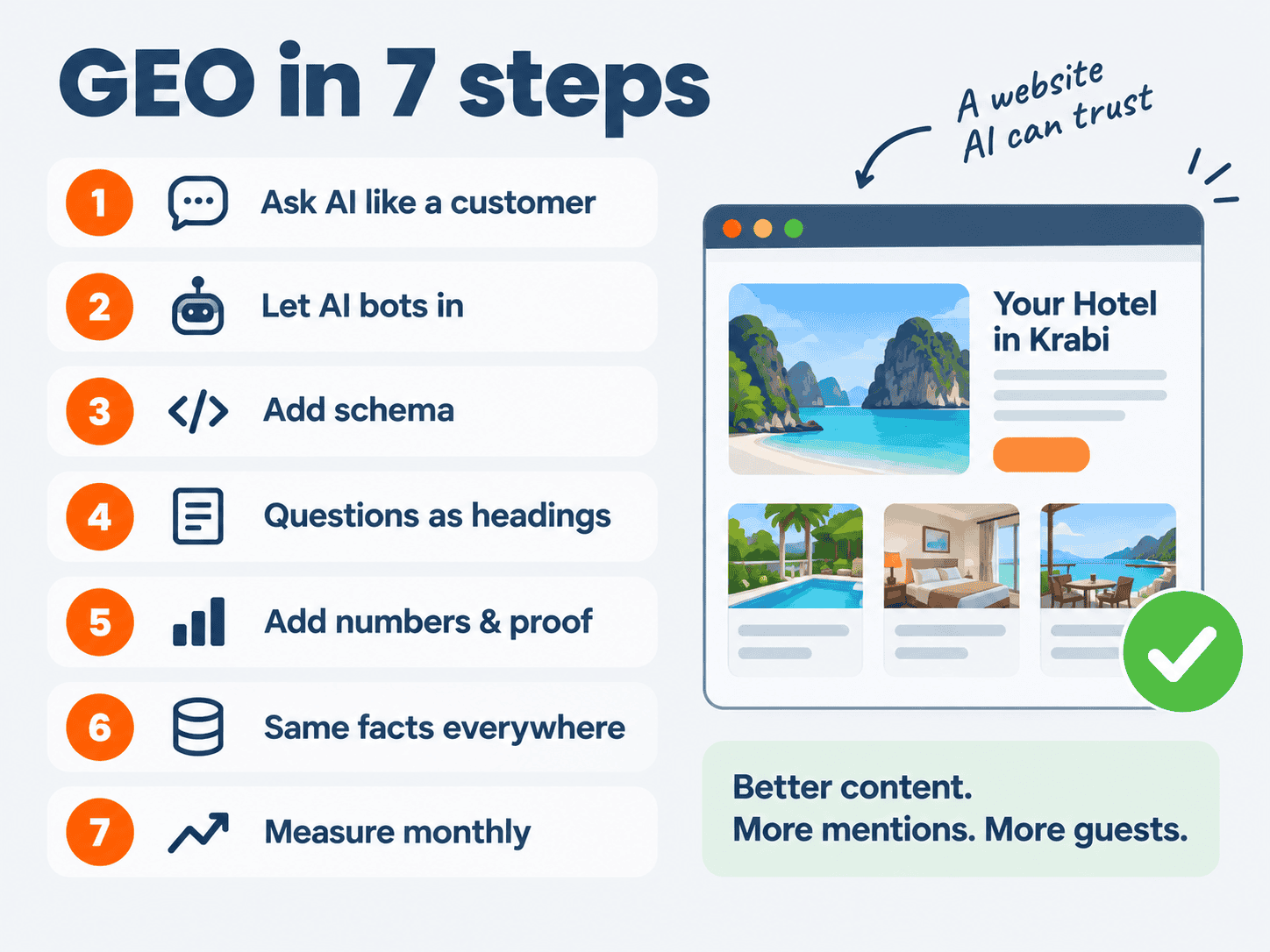
GEO in 7 steps for a small business
You can start with the website you already have.
Step 1: Ask AI like a customer
Open Google, ChatGPT and Gemini and type what a customer would ask, e.g. “best dive shop in Khao Lak”. Note who the AI recommends, which sites it cites, and whether you appear. This is your baseline.
Step 2: Let AI bots in
Check robots.txt and your firewall settings aren’t blocking the AI crawlers you want to see your site.
Step 3: Add schema
At minimum: Organization or LocalBusiness on the home page, Service on service pages, FAQ on pages with common questions.
Step 4: Questions as headings, answers first
Rework key pages so headings match real searches and the first paragraph under each heading answers the question on its own.
Step 5: Add numbers, prices and proof
Price ranges, timelines, client counts, real work and the source of your figures.
Step 6: Make the facts match everywhere
Check name, address, phone, opening hours and services across your website, social media and every platform you’re listed on.
Step 7: Measure monthly
Ask the same questions every month and track whether you’re named more often; check Search Console for growing impressions from long, question-style searches.
| Step | What to do | Who can do it | Rough time |
|---|---|---|---|
| 1. Ask AI like a customer | Note who AI recommends and which sites it cites | Owner | 1 hour |
| 2. Let AI bots in | Check robots.txt and firewall | Web team | 1 hour |
| 3. Add schema | Organization / LocalBusiness / Service / FAQ | Web team | Half a day |
| 4. Questions as headings | Answer fully in the first paragraph | Owner | 1–2 days |
| 5. Numbers and proof | Prices, timelines, real work, sources | Owner | 1 day |
| 6. Same facts everywhere | Name, address, phone, services on every channel | Owner | Half a day |
| 7. Measure monthly | Same questions, plus Search Console | Web team | 1 hour/month |
Proof from Deemmi's own site
We don’t recommend what we haven’t done ourselves. Deemmi’s web design pages follow all seven steps. In mid-September 2026 a search for “web design Phang Nga” showed Deemmi at #1 and cited in the AI Overview, and the Phuket page was cited by the AI Overview within seven days of publishing.
See the live pages: Khao Lak & Phang Nga · Phuket · Krabi. Each uses question headings, direct first-paragraph answers, real prices, FAQ schema and one consistent set of business facts.
Can you do GEO yourself, or should you hire someone?
You can, if you have the time and know WordPress. Steps 1, 4, 5 and 6 are owner-friendly; steps 2, 3 and 7 need technical skills.
| Aspect | Do it yourself | Hire a team that's done it |
|---|---|---|
| Cost | ฿0 but your own time | Service fee |
| Best for | Small sites, time available, comfortable with WordPress | Businesses wanting results fast, or larger sites |
| Hard parts | Schema, robots.txt, measuring AI visibility | Handled for you |
| Risk | A wrong setting can block AI without you noticing | Choose a team with real, checkable results |
If you’d rather have a team that has already done it, see our GEO service or get a free AI visibility check.
Summary About GEO
GEO is about making AI know, trust and name your business in its answers. It doesn’t replace SEO; it builds on it. Most of the work is clear data, direct answers and proof — which also lifts your Google rankings at the same time.
Businesses that start now face little competition, especially in provinces where nobody is doing it yet. Start with a WordPress website built for AI from day one, or let our GEO service upgrade the site you have.
FAQ
Do I have to choose between GEO and SEO?
No. GEO is built on SEO: if Google can’t crawl your site or it loads slowly, AI struggles to use it too. Get the SEO basics right, then add the GEO layer — direct answers, numbers and schema.
How fast does GEO work?
It depends on competition. In low-competition niches we’ve seen a new page cited by AI Overviews within seven days; competitive niches can take two to three months. Measure monthly with the same set of questions.
Is GEO worth it for a small business?
Yes, and small businesses may have the edge. AI chooses on clarity and relevance, not ad spend, so a local business with complete information is often recommended when the customer names a location.
How is GEO different from buying ChatGPT ads?
ChatGPT ads appear in a separate Sponsored box and you pay per click or impression. GEO puts your name inside the answer itself, with no per-click cost. The two can work together.
How do I know whether AI recommends my business?
Ask customer-style questions in Google AI Mode, ChatGPT and Gemini and see if you’re named, and check Search Console for rising impressions from long, question-style searches.
Sources
- Aggarwal et al., GEO: Generative Engine Optimization, KDD 2024 (Princeton / IIT Delhi)
- Google, AI Mode expands to 35 more languages including Thai (Oct 2025)
- Ahrefs, AI Overviews reduce clicks (Mar 2025; re-run Dec 2025)
- Pew Research Center, Google users are less likely to click on links when an AI summary appears (Jul 2025)
- Ahrefs, overlap between AI Overview citations and top-10 rankings (2026)