Skip to content

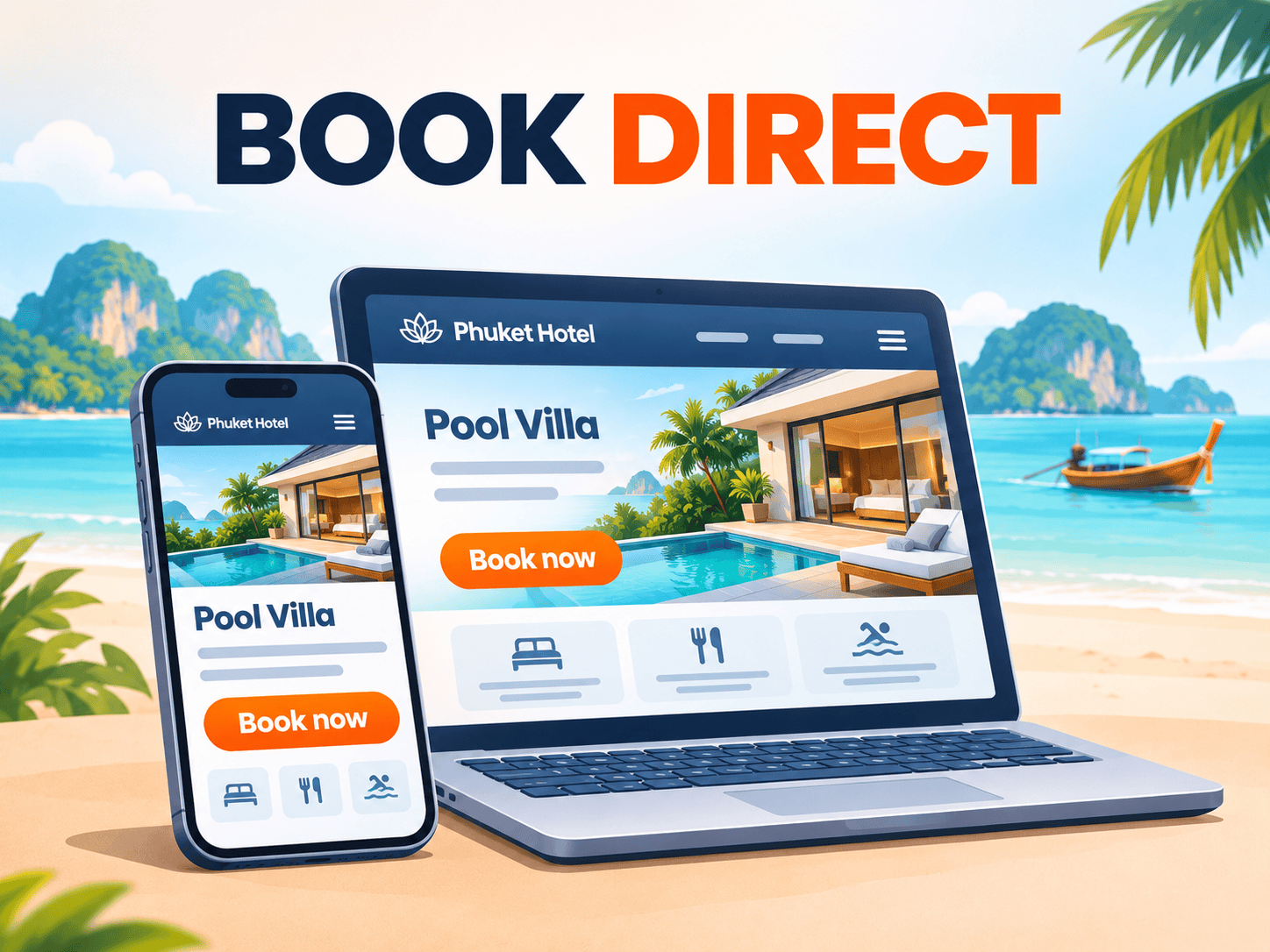
A good Phuket hotel website is not just a room gallery. It has to convince guests who found you on Booking.com or Google to come back and book direct. This guide covers the real cost of OTAs, what makes guests book direct, how villa websites differ from hotel websites, and a checklist to finish before high season.
Why your Phuket hotel website must be ready before high season
Phuket’s high season runs roughly from November to April. It is when rooms sell most easily, and also when OTA commission takes the biggest bite, because the more you sell through them, the more you pay.
Many hotels and villas already have a website, but it only sends guests on to an OTA, or it has a contact form that nobody answers in time. Guests who meant to book direct end up on Booking.com or Agoda because it is easier. A hotel website that works has to make booking direct as easy as an OTA, and better value.
What Phuket hotels really pay OTAs
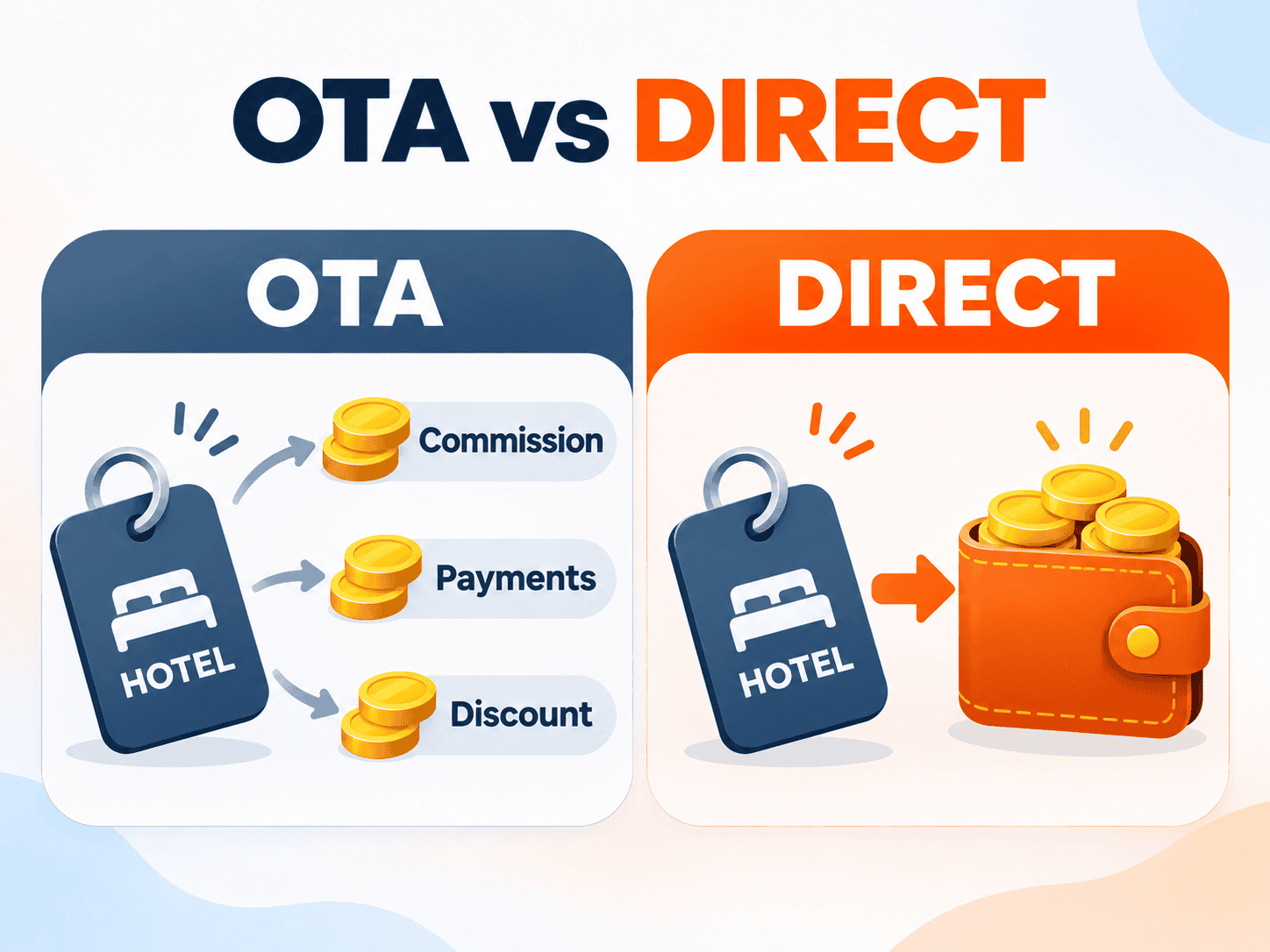
Most owners remember Booking.com’s commission as about 15%. The real cost is usually higher once the add-on programmes and discounts stack up. Hospitality Net’s analysis of Southeast Asian hotels breaks it down like this.
| Item | Approximate share | When you pay it |
|---|---|---|
| Headline commission | About 15% | Every booking |
| Preferred Partner programme | Plus 3 to 5% | When you join to boost ranking |
| Payment processing | 1.1 to 3.1% | When Booking.com collects payment |
| Genius member discount | 10 to 20% off the rate | When you join the programme |
All in, the real cost can go above 28% of booking value. For a worked example with a real resort, see our Krabi hotel direct booking guide; the same calculation works for Phuket properties.
The point is not to drop OTAs. They still help new guests find you. But every booking you move from an OTA to a direct booking is profit that stays with you.
Six things that make guests book direct
1. A reason to book direct
Guests book direct when they get more than they would on an OTA. If your OTA contracts stop you from showing a lower rate, offer perks instead: free breakfast, late checkout, an airport transfer or a spa credit. State clearly on the homepage and room pages what guests get by booking direct. Check the terms of each OTA contract before you set a direct rate below the OTA rate.
2. A booking button on every page, and booking that finishes on your site
Put a “Book now” button in the menu on every page and keep it pinned to the bottom of the screen on mobile. Guests should be able to pick dates, see the price and pay without leaving your site, through a booking engine connected to a channel manager, so availability syncs with every OTA and you avoid double bookings. If the site only has a form and a wait for a reply, many guests will not wait.
3. Several languages and currencies
Phuket guests come from many countries and search in their own language. Your site needs at least Thai and English; if most guests come from one particular market, add that language next, and let the booking engine show prices in the currency guests know. Each language should be its own page that Google can index, not an automatic translate button.
4. Photos and details that answer questions before guests ask
Guests compare your website with OTA listings that are packed with information. Show every room type, room size, bed type, the real view, distance to the beach and the airport, the cancellation policy and check-in and check-out times. Missing information is the reason guests go back to the OTA.
5. Chat channels international guests actually use
Many guests want to ask before booking, especially families and villa groups. Add WhatsApp and LINE buttons that open a chat straight away, and assign someone to answer. A slow reply in high season is a booking handed to an OTA. If messages pile up, AI can answer the basic questions; see our guide to AI booking agents for hotels.
6. Proof that the property is real
Guests who do not know you hesitate to pay an unfamiliar website. Show real reviews from Google or TripAdvisor, your address and map, your hotel licence if you have one, and use a payment method guests recognise. The site must run on HTTPS and load fast on mobile.
How a villa website differs from a hotel website
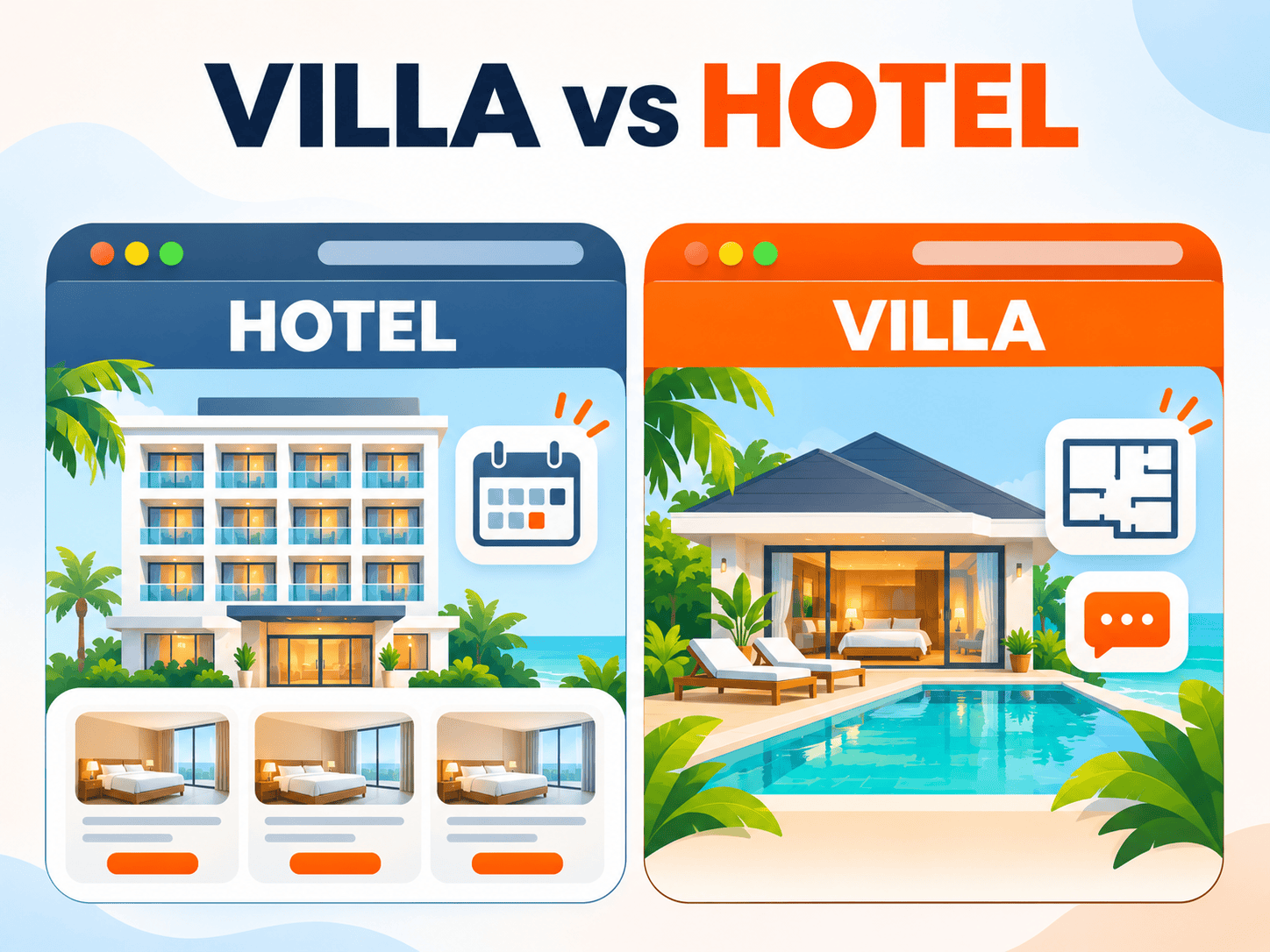
Villas are rented as a whole house, to larger groups, for longer stays, so the website needs a different focus.
| Topic | Hotel website | Villa website |
|---|---|---|
| What you sell | Several room types | The whole house |
| What guests need to see | Room types and facilities | Bedrooms, floor plan, pool, kitchen, maximum guests |
| Booking | Finished on the site through a booking engine | Book on the site, or send a request and chat |
| Terms to state clearly | Cancellation policy | Minimum nights, deposit, security deposit, housekeeping |
| Chat channels | Important | Essential, groups nearly always ask first |
One more thing villa owners should know: Google free booking links (free booking listings in Google’s hotel results) are open to hotels connected through Hotel Center, but an individual vacation rental cannot sign up on its own. It has to go through a property management company that meets Google’s requirements. That makes your own website’s SEO and your Google Business Profile even more important for villas than for hotels.
Get Google to send guests to your website
A beautiful hotel website that nobody finds will not bring direct bookings. Work on three channels alongside the site.
- Google Business Profile. Use your direct booking website as the main link, keep photos current and reply to reviews, because many guests see your property on the map before they see your website.
- Google free booking links. If you run a hotel, ask your booking engine or channel manager provider whether they connect to Google Hotel Center. Once connected, your website’s rate appears next to the OTAs in Google’s results.
- SEO on your own site. Build pages for what guests search for, such as a hotel near Kata Beach, a private pool villa in Rawai or a family hotel in Phuket, in both Thai and English.
Pre-high-season website checklist
Use this table to check your website. Anything missing should be fixed before rooms start to fill.
| Area | What to check | Passes when |
|---|---|---|
| Booking system | Make one real booking on a phone | Booking and payment finish on your site |
| Availability | Close a room in the system and check the OTAs | OTAs close it automatically |
| Direct booking perks | Look at the homepage and room pages | It is obvious what booking direct adds |
| Languages | Open every English page | No page is still in Thai |
| Chat | Tap the WhatsApp and LINE buttons | Someone replies within your set time |
| Google Business Profile | Website link, photos, opening hours | The link goes to your direct booking site, not an OTA |
| Speed and security | Open the site on 4G and check when plugins were last updated | It loads fast and updates are under a month old |
If your current site cannot do these things, or nobody has updated its plugins in a while, it may go down when traffic peaks. Having someone look after it, such as Deemmi Care, keeps the site ready all season.
Building your Phuket hotel website with Deemmi
Deemmi is an Andaman-based web team that builds websites for hotels, resorts and villas. The property websites we build are designed to connect to a booking engine and channel manager from day one, come in Thai and English, and are structured so Google can find them. See our Phuket web design agency page for details. A standard 5-page website starts from 25,000 THB and takes about 4 to 6 weeks. If you already have a website, send us the link and we will tell you whether to improve it or rebuild.

Summary
A Phuket hotel website wins direct bookings when booking direct is as easy as an OTA and better value. It needs a reason to book direct, booking that finishes on your site, several languages, complete information, fast replies on chat and proof that the property is real. Villas need more whole-house detail and pre-booking contact than hotels, and both need Google to send guests to the site through a Google Business Profile and SEO. If you want your site ready before high season, look at building your hotel website with Deemmi and message us on LINE.

FAQ: Phuket hotel websites
I already have a Booking.com listing. Do I still need my own hotel website?
Yes. OTAs help new guests find you, but every booking carries a commission. Your own website captures guests who already know you and returning guests without commission, and it is a channel where you control the price and the information.
Does a hotel website need its own booking system?
It should. With only a contact form, guests have to wait for a reply and many go back to an OTA. The booking system should connect to a channel manager so availability matches every OTA and you avoid double bookings.
How many languages should a hotel website have?
At least Thai and English, then add languages based on where most of your guests come from. Each language should be its own page that Google can index, not an automatic translate button.
Can a villa rental appear in Google free booking links?
An individual villa cannot sign up on its own; it has to go through a property management company that meets Google’s requirements. Villas should focus on their Google Business Profile and on SEO for their own website.
How long does it take to build a Phuket hotel website?
A standard 5-page website with Deemmi takes about 4 to 6 weeks. Connecting a booking engine or adding more languages takes longer, so it is best to start before rooms begin to fill.