Most business websites don’t fail because they look bad. They fail because they’re missing fundamentals — and the fundamentals don’t show up in a design review. A site can be visually beautiful and still bleed customers in the first 10 seconds because the visitor doesn’t understand what the business does, can’t find what they came for, can’t load it on mobile, or can’t take the next action without hitting friction.
Here are the 8 components we check on every SME website we audit. None of them are flashy. All of them are the difference between a site that costs you money and a site that pays for itself.
Component 1: Clear positioning in 5 seconds
When a visitor lands on your homepage, they should know three things within five seconds — who you are, what you do, and why they should care. Not in marketing language, in plain words. “Bangkok-based digital agency for SMEs that need bilingual marketing” beats “Empowering brands through synergistic solutions” every time.
This sounds obvious. In practice, most SME homepages fail it. The hero says something poetic, the subhead is vague, and the visitor scrolls without ever forming a clear picture. They bounce. You never know they were there. Test your own hero by asking someone outside your team to read it for five seconds, then describe your business in their own words. If they can’t, your positioning is broken — and no amount of design polish will fix it.
Component 2: Mobile-first design (not just responsive)
In Thailand in 2026, around 80% of website traffic for SMEs comes from mobile. “Responsive” — meaning the desktop site shrinks to fit a phone — isn’t good enough anymore. Mobile-first means the experience is designed for the phone first, then expanded for desktop.
The difference shows up in tap targets, font sizes, form length, image weight, and where the CTAs live. A responsive site puts the contact form below a long hero. A mobile-first site puts the LINE button thumb-accessible at the bottom of the screen, so the visitor can act without scrolling.
Component 3: Page speed that respects the visitor's data plan
A 2-second load time used to be the goal. In 2026 with mobile-first traffic, the threshold has dropped to 1.5 seconds for the Largest Contentful Paint. Anything slower and you’ve lost 30–40% of the visitors before the page renders.
The biggest culprits are image weight (uncompressed photos in the hero), heavy third-party JavaScript (Facebook Pixel, Google Tag Manager, chat widgets all loading at once), and unused CSS from page builders. The fix isn’t sexy — compress images to WebP, defer non-critical JS, generate critical CSS, and use a caching plugin like Hummingbird or WP Rocket. Done properly, a Thai SME WordPress site can hit PageSpeed Mobile scores in the 80s and 90s, and the conversion lift from that alone often pays for the build.

Component 4: Conversion architecture (CTAs that actually convert)
Most SME websites have a “Contact Us” link in the menu and consider that done. A working site has a conversion architecture — a deliberate path from “visitor curious” to “qualified lead.” That means primary CTAs in the hero, secondary CTAs after every key section, a sticky thumb-accessible button on mobile, and a clear next step at the bottom of every page that isn’t the same generic “Contact Us.”
The copy on the CTA matters too. “Get a Free Quote” outperforms “Submit” by 30–50% in most A/B tests because it sets expectations. “Talk to Us on LINE” outperforms a contact form when your audience prefers chat. Localizing the CTA to the channel your customers actually use is one of the highest-leverage decisions you’ll make. For a deep-dive on lead capture, our work covers the full funnel from hero CTA to follow-up sequence.
Component 5: SEO foundation that compounds
A new website without SEO foundations is a brochure. A new website with SEO foundations is an asset that compounds month over month. The non-negotiable basics are a properly structured H1/H2/H3 hierarchy, schema markup (LocalBusiness, Organization, BlogPosting, FAQPage where relevant), clean internal linking with descriptive anchor text, an XML sitemap submitted to Google Search Console, title tags and meta descriptions written for click-through rather than keyword stuffing, and image alt text written for accessibility AND search.
None of these are exotic. All of them are routinely missing on sites built by tools that optimize for design rather than discoverability. Our engagements often start with these basics on sites that have been “live” for two years without a single ranking page.
Component 6: Local trust signals that close the gap
Thai customers, especially SMEs and B2C audiences, decide in seconds based on signals of legitimacy. A working business website has real client logos with permission (not generic stock badges), case studies with actual numbers (not “Increased ROI by 300%” with no context), recent Google Business Profile reviews embedded or linked, a real office address on the contact page (not just an email form), and founder photos with short bios linked to LINE or LinkedIn.
These signals do two things at once — they reassure a hesitant buyer, and they signal authority to Google for E-E-A-T purposes. Removing stock photos and replacing them with real team shots is the highest-leverage 60-minute change we make on most audit engagements.
Component 7: Analytics and a feedback loop
You can’t improve what you don’t measure. The basics every SME site should have running from day one are Google Analytics 4 with conversion events on key actions (form submit, LINE click, phone tap), Google Search Console connected and verified, a heatmap tool (Microsoft Clarity is free and excellent) running on key landing pages, and a monthly review of which pages drive leads and which leak them.
Without this, every design and copy decision after launch is a guess. With it, you have a feedback loop that gets sharper every month. We cover the measurement layer fully in our engagements, because paid traffic without measurement is the most expensive way to learn nothing.
Component 8: AEO readiness (the new must-have for 2026)
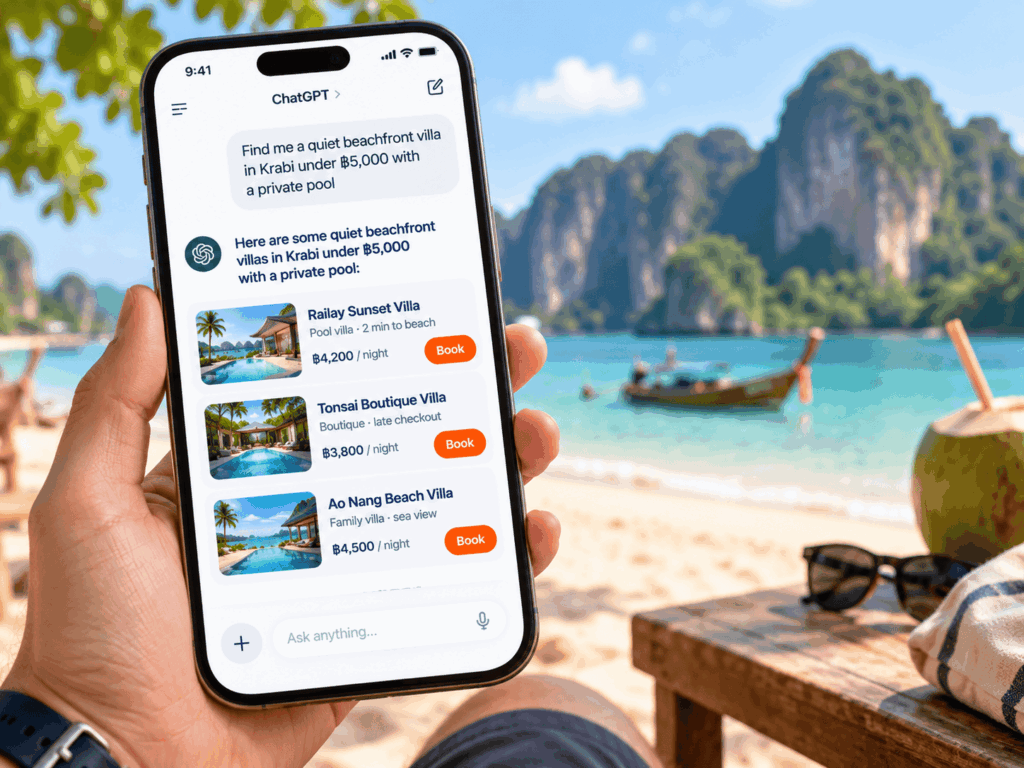
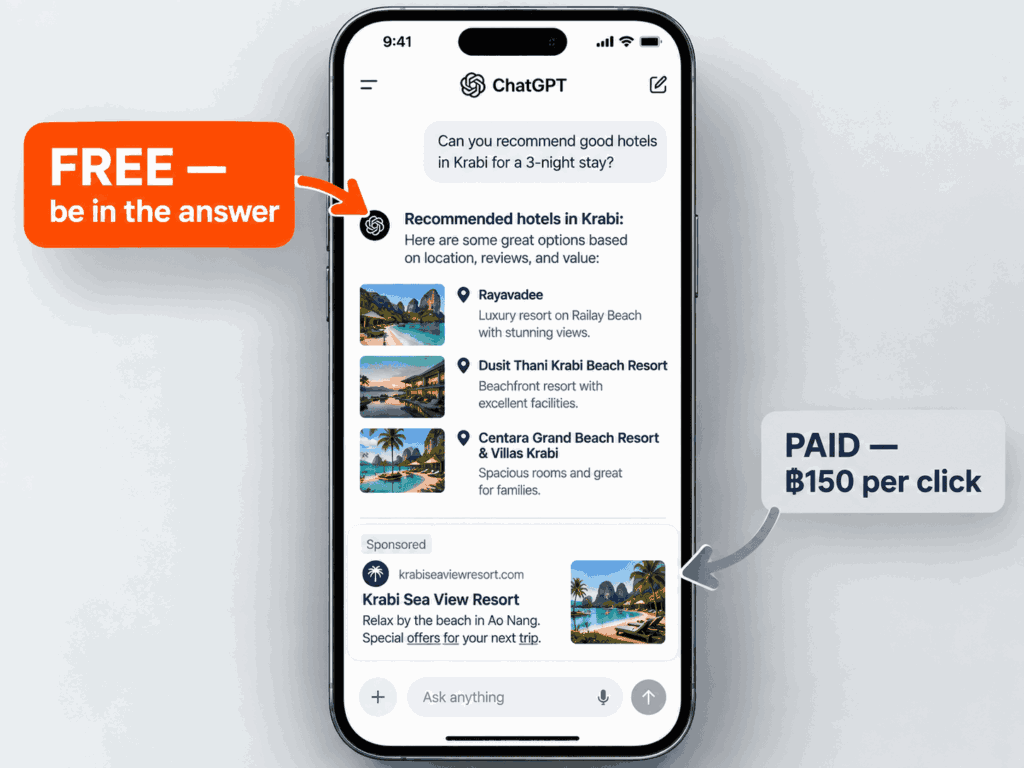
This is the one that didn’t exist three years ago and is now non-negotiable. AEO — Answer Engine Optimization — is how your business appears in answers from ChatGPT, Perplexity, Gemini, and Claude when potential customers ask AI for recommendations.
In 2026, around 30% of search-style queries in Thailand happen in an AI chat interface, not on Google. If your website isn’t structured for AI engines to parse — clean semantic HTML, FAQPage schema, llms.txt file at root, clear positioning in early paragraphs — you’re invisible to that 30% and growing. We’ve gone deep on the playbook in our piece.
The hierarchy that actually matters
If you can’t ship all eight at once — and most SMEs can’t on a first build — sequence matters. Get positioning, mobile-first, and page speed right first because they affect every visitor. Then SEO foundation and conversion architecture because they affect every lead. Then trust signals, analytics, and AEO readiness because they affect every conversion and every future improvement.
A site that hits all eight isn’t expensive — it’s about 30,000–60,000 baht of disciplined work upfront. A site that misses three or four of them costs you forever in lost leads, lost rankings, and the eventual rebuild.
Ready to bring your business online with a strategy that actually works? Let’s talk — reach us at info@deemmi.com or chat with our team on LINE @deemmi.
FAQ
A custom WordPress SME website with all 8 essentials runs 30,000–60,000 baht for setup, plus 1,500–3,500 baht per month for hosting, domain, SSL, and core plugins. Total 12-month cost typically lands at 50,000–100,000 baht all in.
A standard 5–8 page SME website with proper SEO, conversion architecture, and mobile-first design takes 4–6 weeks. Larger sites with e-commerce or custom integrations run 8–12 weeks.
Clear positioning in the hero. If a visitor doesn’t understand what your business does in 5 seconds, none of the other components save the site. Fix positioning first, then everything else compounds on top.
You probably underestimate how many do. In Thailand in 2026, around 30% of search-style queries already happen in AI chat interfaces. Even if your specific customer doesn’t, your competitor’s customer probably does — and AEO is how they’re getting recommended.
Most can be added to an existing site without a full rebuild. SEO foundation, schema, trust signals, analytics, and AEO readiness are retrofits. Mobile-first design, positioning, and conversion architecture sometimes require a partial rebuild depending on the current structure.
Yes. Page speed is one of the few SEO inputs that also directly affects conversion. Slower sites lose visitors before they see your offer — and Google has been weighing Core Web Vitals as a ranking input since 2021.
Some yes, some no. Mobile-first, positioning, trust signals, analytics, and CTAs are platform-agnostic. SEO foundation, AEO readiness, and customization for Thai market specifics tend to be where hosted platforms hit walls. We unpacked the platform tradeoffs in our piece.
Conversion architecture — specifically optimized CTAs and mobile lead capture. The change is fast (often days), measurable in the first week of traffic, and directly affects lead volume. Most other components compound more slowly but cost less to maintain.