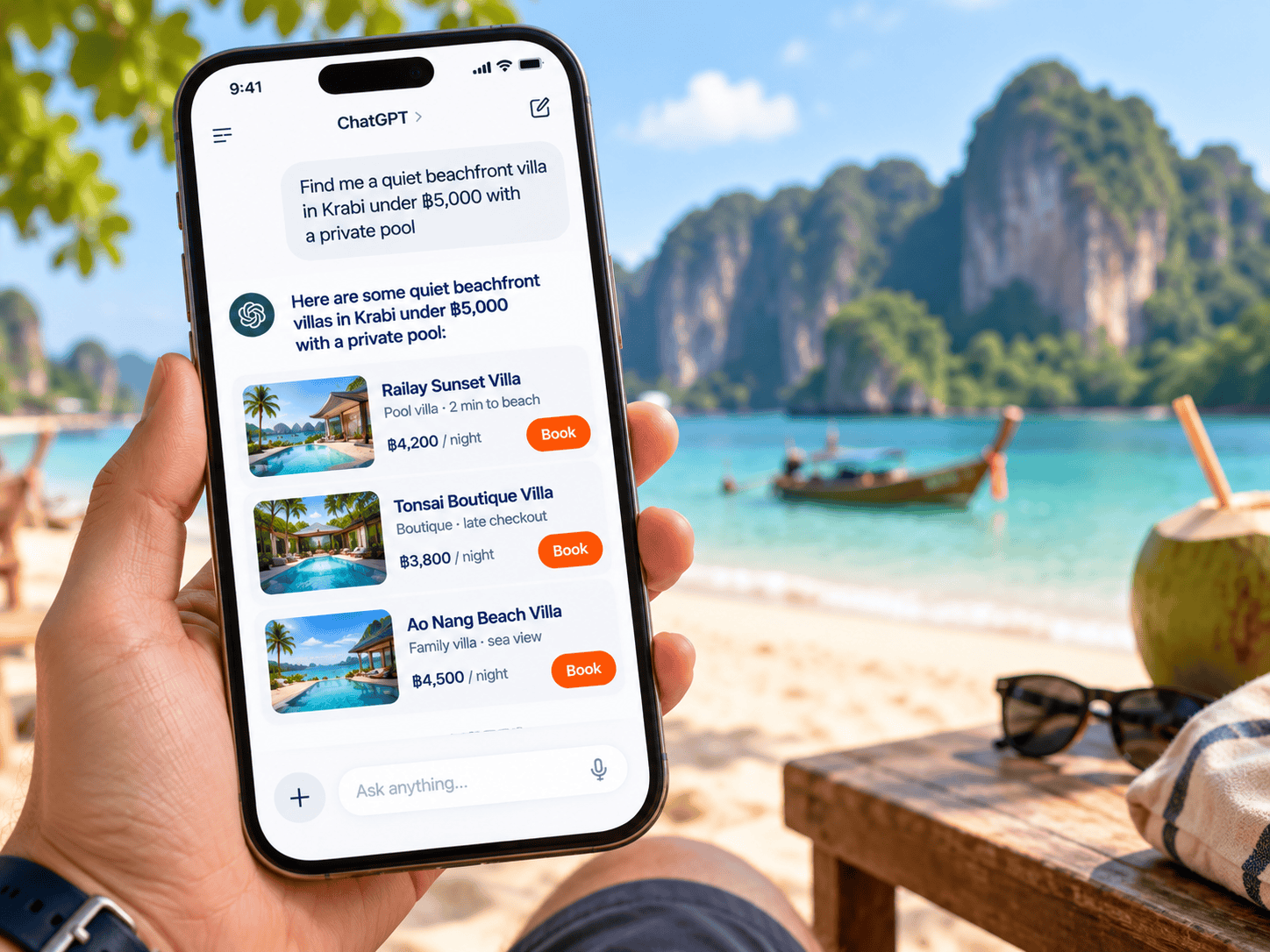
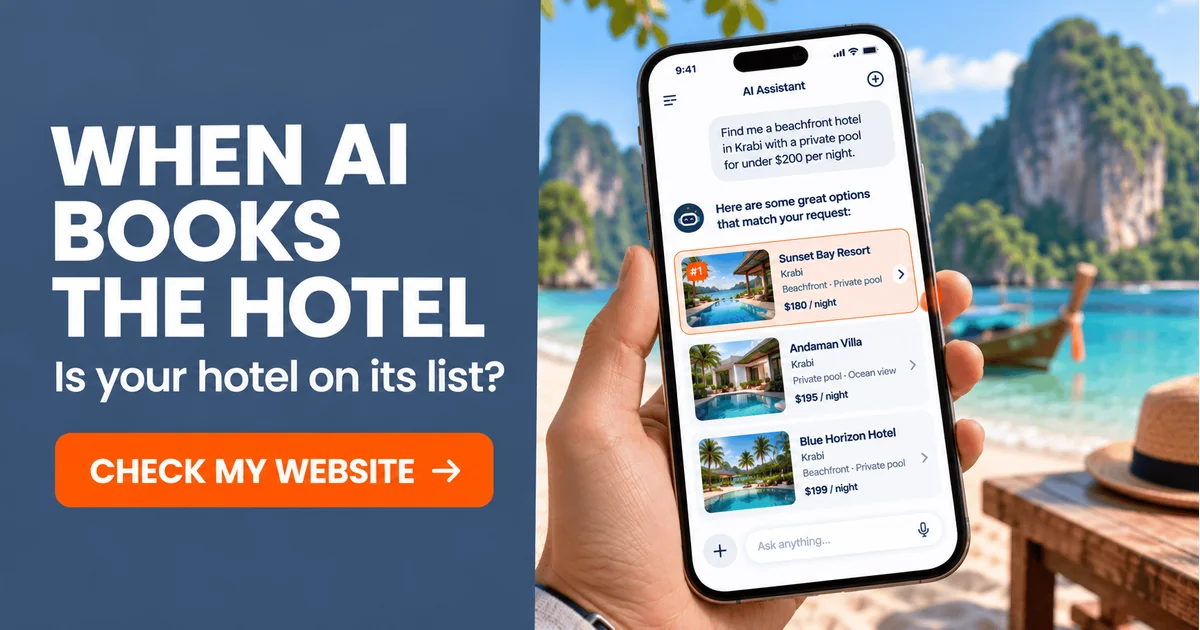
Picture a traveller typing into their phone: “Find me a quiet beachfront villa in Krabi under ฿5,000 a night, private pool, late checkout.” Ten seconds later an AI offers three properties, explains why each fits, and asks which one to book.
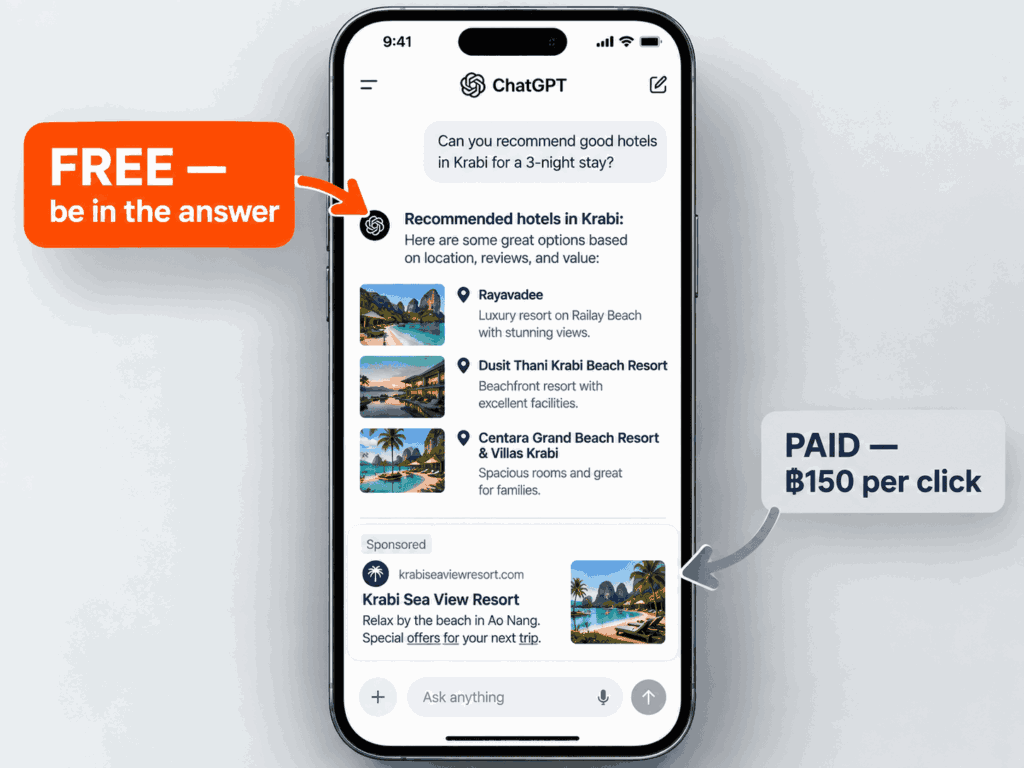
No Booking.com, no ten browser tabs, no 200 reviews — and this isn’t the future any more. Since late August 2026 Google lets people in the US find and book hotels inside its AI chat, and in Thailand ChatGPT just opened ads in Thailand at the end of September. For an independent hotel owner the question isn’t “will it come” but “when the AI picks those three, is my property one of them?”
📅 Information as of 4 October 2026. This is moving fast; we’ll update when anything changes in Thailand.
Can AI really book hotels for people yet?
The AI hotels already know is the chatbot that answers “what time is check-in?” The new generation — the industry calls it agentic AI — goes further: it acts on the traveller’s behalf. It searches many sources, filters by detailed preferences, checks real availability and price, compares value, and takes the traveller right up to payment.
What has actually happened so far:
- Oct 2025 — Expedia and Booking.com launched apps inside ChatGPT that compare hotels with live pricing. Expedia said AI traffic is still small but converts to bookings at higher rates than other traffic
- 27 Aug 2026 — Google opened hotel booking inside AI Mode, completed in the chat with Google Pay (US, English first). The hotel or OTA still charges the card and sends the confirmation
- Sep 2026 — Meta launched an AI agent that can book travel, and Expedia announced hotel bookings through Meta’s AI
One nuance matters: Google stresses its AI does not book on its own — the traveller still chooses the room and approves payment. But everything before that — searching, filtering, comparing, recommending — the AI already does. So if the AI doesn’t surface your hotel, the guest never sees you.
Who is building AI that books hotels
Every major player is in, each taking a different route.
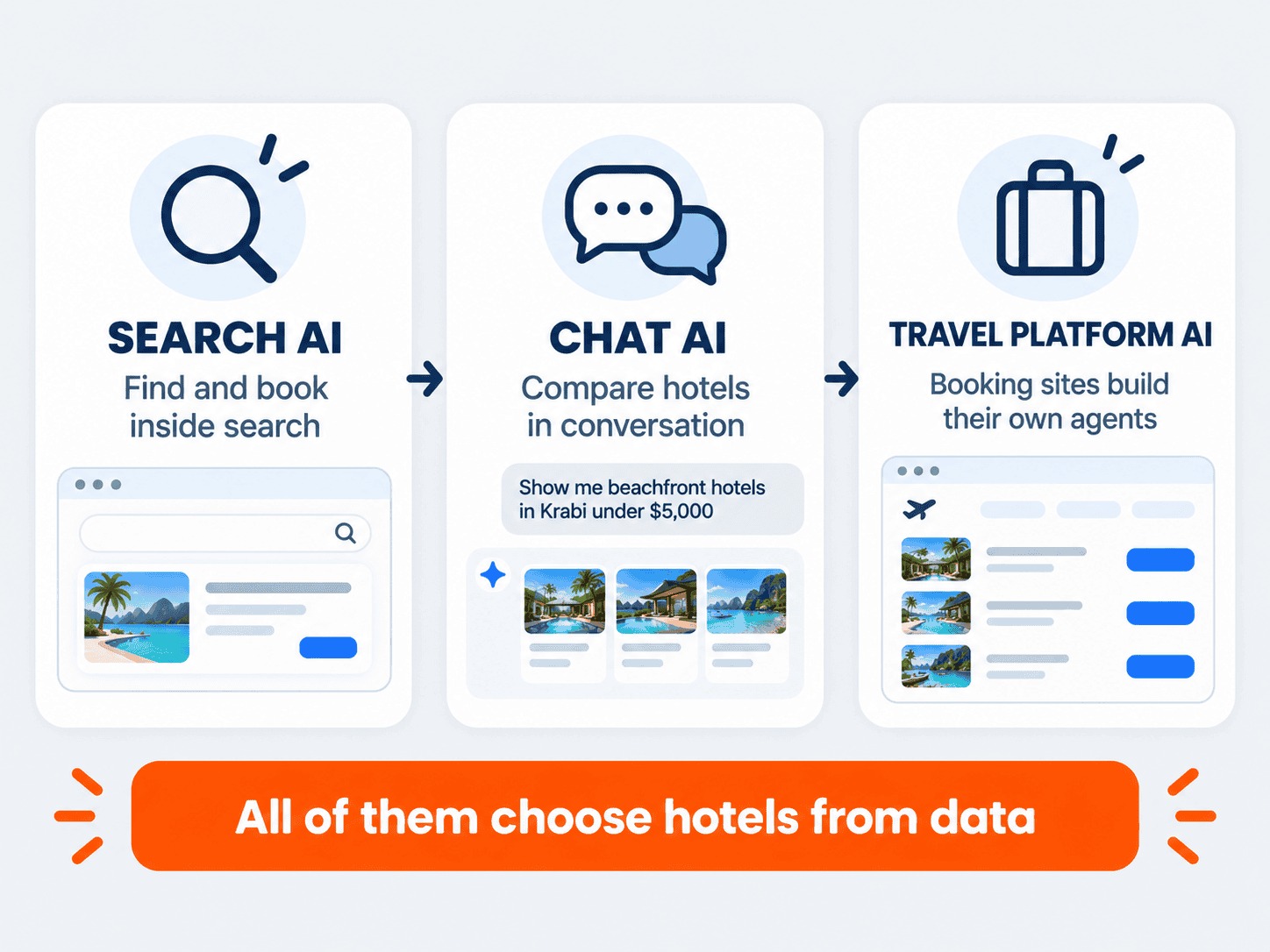
| Who | What they've done | Status / partners |
|---|---|---|
| Google AI Mode | Find, compare and book hotels inside the chat, pay with Google Pay (27 Aug 2026) | US, English first · Booking.com, Expedia, Hilton, Marriott, IHG, Choice, Wyndham, Priceline, Hotels.com, Trip.com |
| ChatGPT | Expedia and Booking.com apps in chat, comparing hotels with live prices (Oct 2025) | Many countries · still hands off to the OTA to book |
| Meta | AI agent that can book travel (Sep 2026) | Expedia selling hotels through Meta's AI |
| Booking Holdings | AI across discovery and post-booking service | Partnering with OpenAI, Google, Anthropic, Amazon |
| Independent hotels | — | Not on any partner list — must be found through their own data and website |
As of 4 Oct 2026, from Skift, PhocusWire, Hotel Tech Insight
Look at the last column: Google’s launch partners are OTAs and the big chains — Booking.com, Expedia, Hilton, Marriott, IHG. Not a single independent hotel.
Why independent hotels are most at risk
Chains have full-time digital teams; when AI booking goes mainstream, Marriott and Hilton adapt overnight. A 20-room resort in Ao Nang or Khao Lak doesn’t have that team.
The real risk isn’t a lower ranking, it’s invisibility. On Booking.com, position 40 still gets scrolled to. If the AI shortlists three and you’re not among them, the guest never learns you exist.
The flip side is the best opportunity independents have had in a decade. AI chooses on data and quality, not ad spend. A 25-room property with clear data, strong reviews and real character can be recommended ahead of a chain when the traveller asks for “boutique, quiet, characterful” rather than “the same as every other branch.”
What AI uses to decide which hotels to recommend
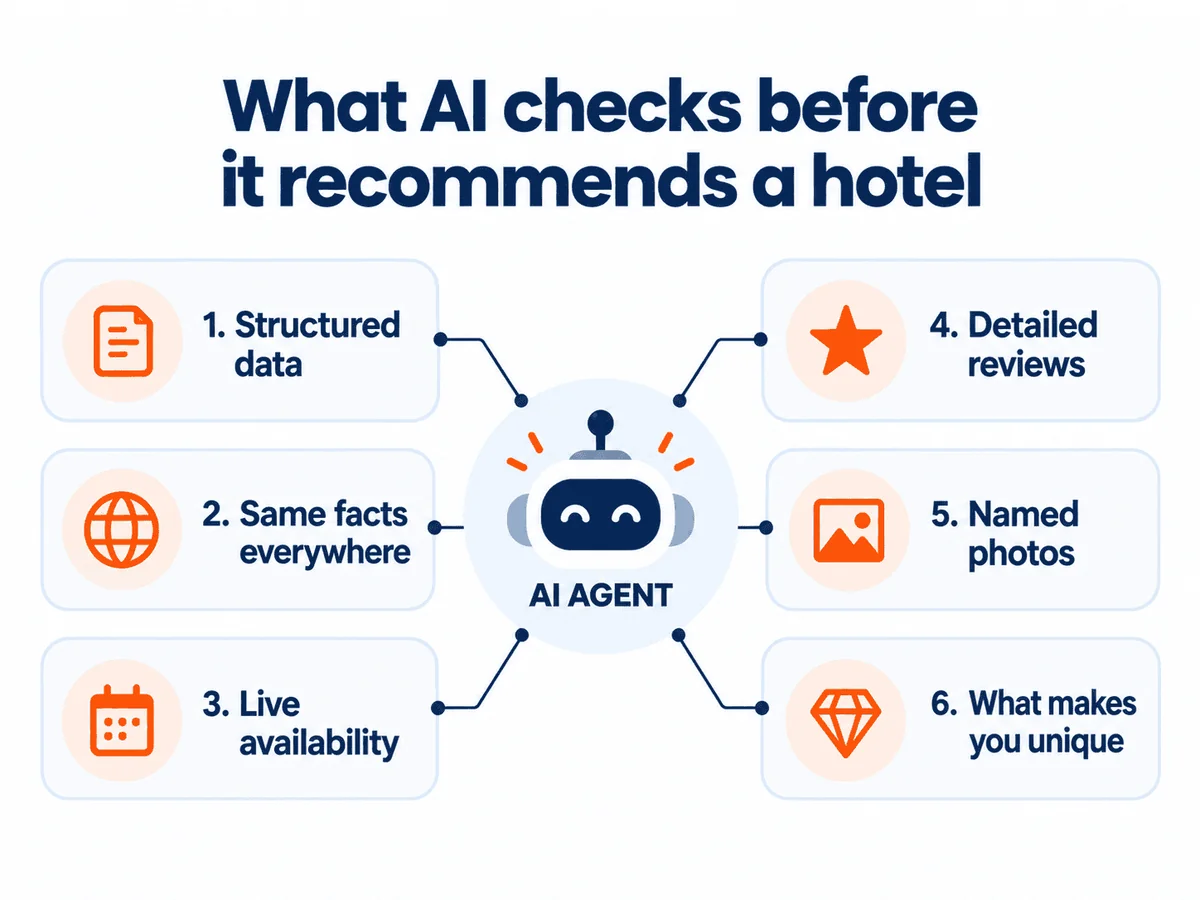
AI doesn’t look at pretty photos the way a person does. It reads data and scores trust. Hotel-tech specialists point to six signals.
1. Data AI can read (structured data)
Your website should carry Hotel or LodgingBusiness schema markup — code guests never see, but which tells AI exactly which room types you have, amenities, coordinates, price range and check-in/out times. Without it, AI has to guess from text, which is less reliable and puts you at a disadvantage. It’s the core of getting your business recommended by AI.
2. The same facts everywhere
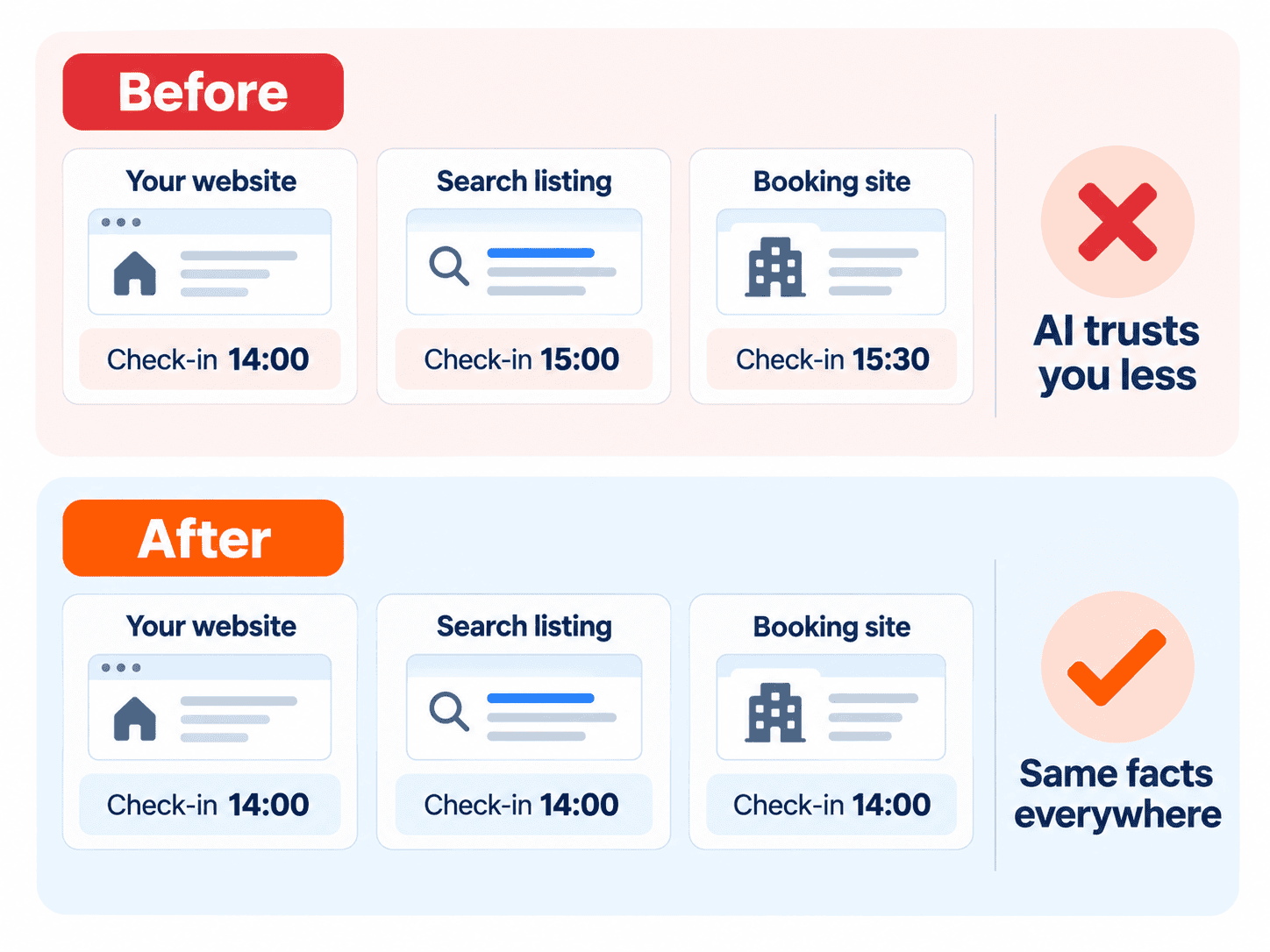
AI cross-checks sources. If your website says check-in at 14:00, your Google listing says 15:00 and Booking.com says 15:30, the AI trusts you less. Specialists note that inconsistent data is worse than having no schema at all.
The fix takes an afternoon: list room types, check-in/out times, key amenities and price bands, then check they match on your website, your Google listing and your top three OTAs.
3. Live availability
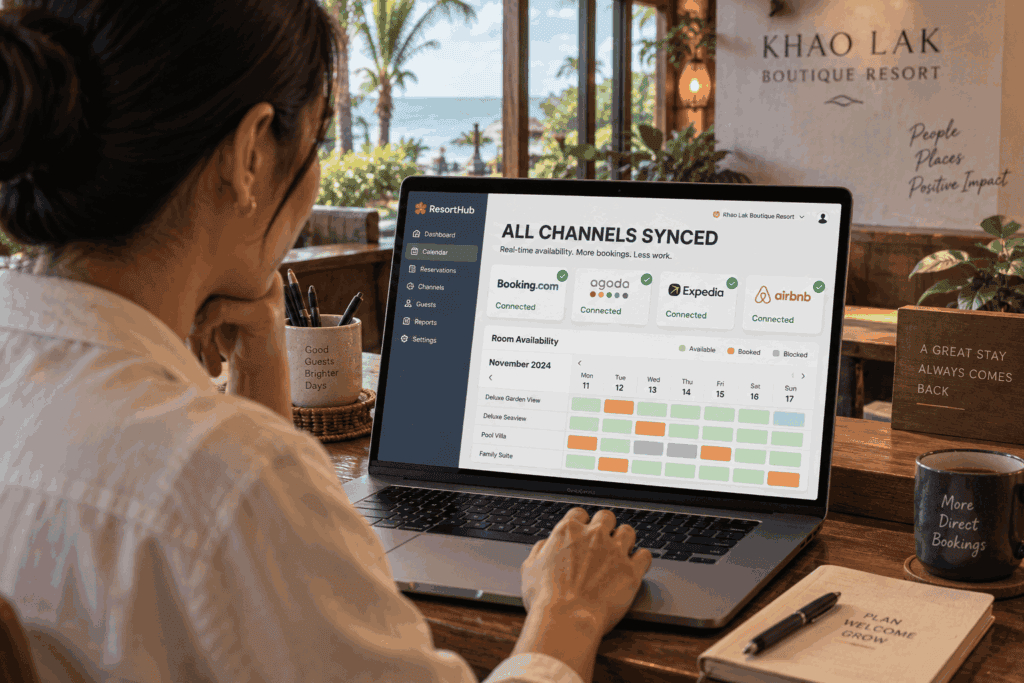
AI needs to be sure a room is really free before recommending it. A sold room still showing as available marks you as unreliable — which is why a channel manager that syncs instantly, not in hourly batches, matters more than ever.
4. Detailed reviews
AI reads review content, not just stars. “Quiet room, two minutes to the beach, local fruit at breakfast” is worth ten times “5 stars, great.” Encourage detailed reviews and reply to every one.
5. Photos with names and descriptions
A file named pool-villa-sea-view-ao-nang.webp described as “Pool villa with sea view in Ao Nang” tells AI far more than IMG_4521.jpg.
6. What makes you unique
“Nice resort, great location” tells AI nothing. “Twelve wooden houses in an old rubber garden, 300 metres from Klong Muang beach, southern Thai cooking class every evening” lets it match you to the right guest instantly.
| What AI checks | Why it matters | What the hotel must do |
|---|---|---|
| 1. Structured data | AI reads rooms, prices and location clearly instead of guessing | Add Hotel / LodgingBusiness schema to the website |
| 2. Same facts everywhere | Conflicting data is worse than no schema | Audit rooms, check-in, amenities, prices across website, Google, OTAs |
| 3. Live availability | A sold room still showing as free = unreliable | Use a channel manager that syncs instantly, not in batches |
| 4. Detailed reviews | AI reads content, not just stars | Encourage detail, reply to every review |
| 5. Named photos | File names and alt text tell AI what the photo shows | Rename files, add alt text to every image |
| 6. What makes you unique | AI matches hotels to very specific guest wishes | Rewrite descriptions to be specific, cut generic phrases |
When AI books, where does the money go
This is the question owners should ask most, because “AI booked it” doesn’t automatically mean a direct booking. It depends on whose AI it is and where it pulls the room from.
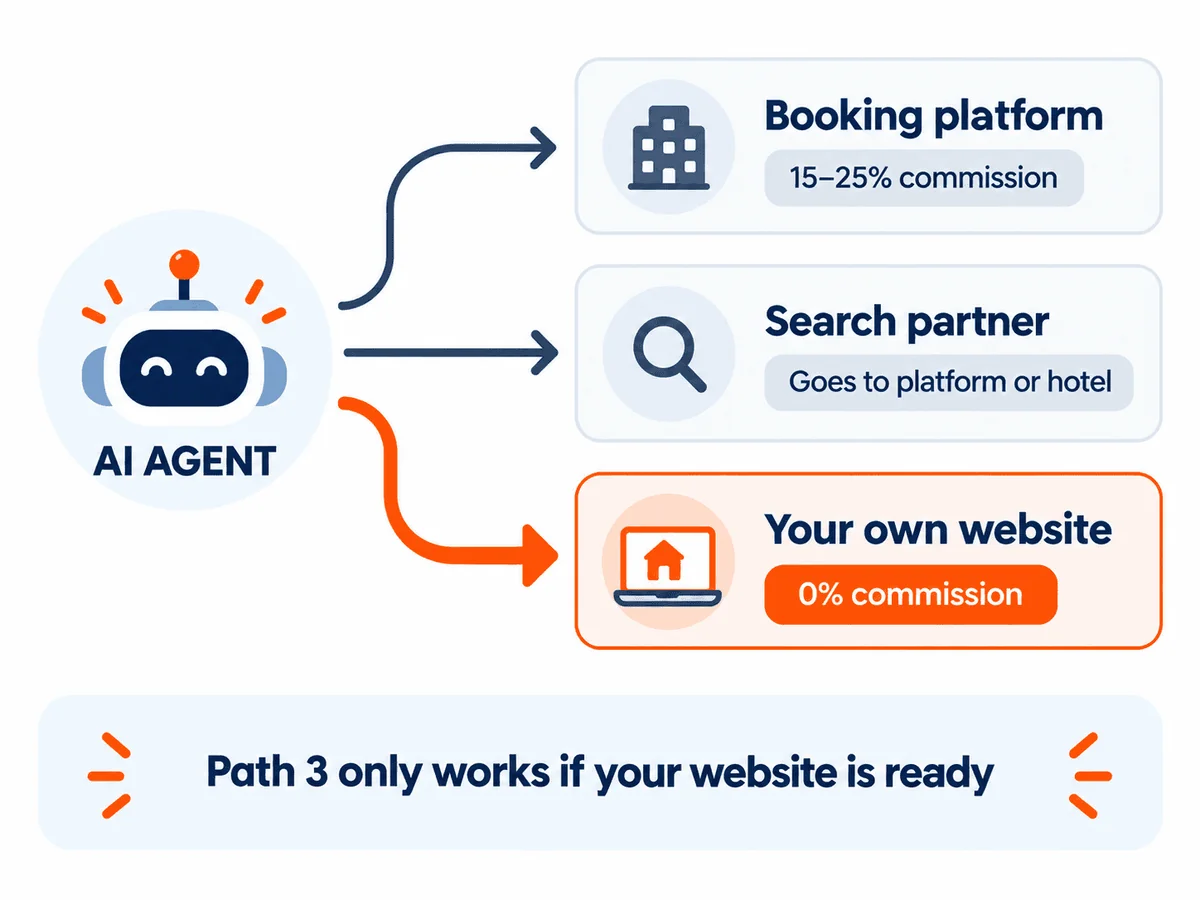
| Path | What happens | Commission |
|---|---|---|
| 1. OTA's AI | Booking.com / Expedia AI recommends and books — an OTA booking with a new interface | 15–25%, as before |
| 2. Search AI | Google's AI picks from partners, then hands off to the OTA or the hotel | Depends where it lands |
| 3. AI recommends your website | AI reads your hotel site, recommends it in the answer, the guest books direct | 0% — but only if your website is ready |
Path 3 is our view, based on how AI search currently cites source websites
In our view there’s one conclusion: nobody can deliver path 3 for you except you. Path 1 the OTA handles (for commission). Path 2 depends on whether your data is good enough. But path 3 — AI reads your website, recommends it in the answer, and the guest books direct — only happens if your website is ready. If it isn’t, every AI booking flows to path 1 and you keep paying the OTA commission you already pay for years to come.
When will this reach Thailand
As of writing, hotel booking inside Google AI Mode is US and English only. The Booking.com and Expedia apps in ChatGPT work in many countries but still hand off to the OTA to finish the booking. Hotel-tech specialists expect this timeline:
| Period | Expected | What hotels should do |
|---|---|---|
| 2026 (now) | Infrastructure year — big players launch, early adopters experiment, most bookings unchanged | Organise data, add schema, make facts consistent — low cost, helps Google today |
| 2027–2028 | AI assistants become standard on phones; AI-influenced bookings grow clearly | Measure AI-referred visitors, adapt content to the questions guests ask AI |
| 2029 onward | AI may become a main booking channel for a large segment, as OTAs once replaced older channels | Early movers hold a compounding advantage |
Timeline based on Hotel Tech Insight's forecast — not established fact
For the Andaman there’s one more angle: our core guests are European, not Thai. Scandinavian, German and British travellers will use AI booking sooner, because these features always launch in English first. Hotels selling mainly to foreigners will feel this before hotels selling to Thais.
Proof it works
We don’t recommend what we haven’t done ourselves. Deemmi’s own site runs on these same principles — structured data, consistent facts on every page, content that answers questions directly. Search “web design krabi”, “web design phang nga” or “web design phuket” today and Google’s AI Overview lists Deemmi first or near the top — the Phuket page got there seven days after publishing.
See for yourself: Krabi · Khao Lak & Phang Nga · Phuket · Koh Samui & Surat Thani
The same principles apply to a hotel website point for point — the AI recommending a web agency and the AI recommending a hotel read websites the same way.
What to do this month
No new systems, no building your own AI. This is data and website work.
- Check whether your site has Hotel schema — not sure? Have us check your hotel website free or send the link on WhatsApp; answer within one day
- Run a one-page data audit — room types, check-in/out, amenities, price bands, matched across website, Google and your main OTAs
- Test your channel manager — make one test booking and time how many minutes the room takes to disappear from the OTAs
- Rename the photos on your site so they say what they show, and add alt text
- Rewrite your property description to be specific; cut generic phrases like “great atmosphere” and “convenient location”
- Encourage detailed reviews and reply to all of them
Summary
AI booking won’t arrive like a switch flipped overnight. It will flow in gradually — and it will flow in from foreign travellers first, who are the Andaman’s core market.
Hotels that prepare now won’t see a sudden jump, but they’ll be in the right place when the wave comes, like hotels that built websites in 2005 or claimed OTA listings in 2010. And every step here also improves your Google visibility and your OTA performance today — nothing is wasted.
It all starts with a hotel website AI can read from day one.
FAQ
Can AI book hotels for travellers in Thailand yet?
Not fully. As of October 2026, completing a hotel booking inside Google AI Mode is US and English only. OTA apps inside ChatGPT can already find and compare properties but hand off to the OTA to book. Foreign travellers can, however, already use AI from their home country to research hotels in Thailand.
Should a 10–20 room hotel care about this?
Yes — and it may benefit more than the chains. AI chooses on data and distinctiveness, not ad spend, so a small hotel with clear data and a clear identity can be recommended when a guest asks for something boutique or characterful.
Should I drop the OTAs?
No. OTAs are building their own AI, and strong content on Booking.com and Expedia lets their AI recommend you too. What matters is that your OTA content and your website match, and that your channel manager syncs instantly.
Do I need to buy new systems?
Mostly not. The core work is organising data on your website — schema, descriptions, photos — and making it consistent everywhere. If you already have a channel manager, check it syncs in real time. If your site is very old or you don’t have one, rebuilding may be better value.
Where should I start?
Check whether your website has Hotel schema, and audit your core facts so they match everywhere. Both take little time and have the biggest effect — on AI and on Google today.
Sources
- Skift — Google’s Agentic Hotel Booking Tool Comes to AI Mode (27 Aug 2026)
- PhocusWire — ChatGPT brings apps into chat, starting with Expedia and Booking.com (7 Oct 2025)
- PhocusWire — Meta launches AI agent with travel booking capabilities; Expedia to offer hotel bookings through Meta’s Muse AI agent (Sep 2026)
- Hotel Tech Insight — Agentic AI Hotel Booking: 2026 Survival Guide for Independents (updated 1 Jun 2026)